The Lord spoke to Moses: “Tell the Israelites to take an offering for me. You are to take my offering from everyone who is willing to give. This is the offering you are to receive from them: gold, silver, and bronze; blue, purple, and scarlet yarn; fine linen and goat hair; ram skins dyed red and fine leather; acacia wood; oil for the light; spices for the anointing oil and for the fragrant incense; and onyx along with other gemstones for mounting on the ephod and breastpiece. They are to make a sanctuary for me so that I may dwell among them.
(Ex 25.1-8)
I was glad when they said to me, “Let us go to the house of the Lord!”
(Ps 122)
“Our ancestors had the tabernacle of the testimony in the wilderness, just as he who spoke to Moses commanded him to make it according to the pattern he had seen…. But Solomon built a house for him. Yet the Most High does not live in houses made by human hands, as the prophet says, ‘Heaven is my throne and the earth is the footstool for my feet. What kind of house will you build for me, says the Lord, or what is my resting place? Did my hand not make all these things?.’
(Ac 7.44,47-50)
“For where two or three are gathered together in my name I am there among them.”
(Matt 18.20)
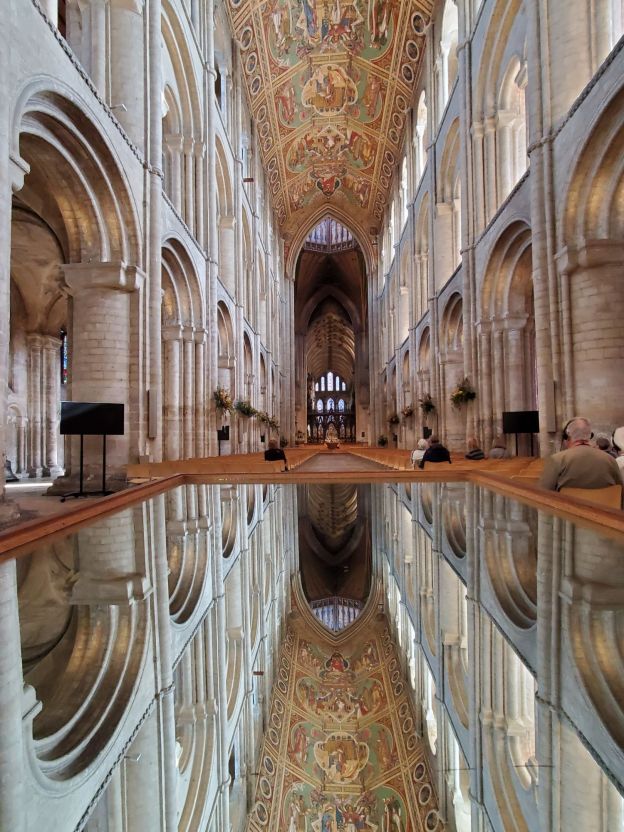
What is it that makes the psalmist glad, when he is invited to join the procession to God’s house? When we read in Exodus of the precious materials used to create the tabernacle, and in 1 Kings of the extraordinary wealth which was poured into the temple constructed by Solomon, it is easy to imagine that the gladness stemmed, at least in part, from experiencing so much beauty at close quarters. And perhaps in part that was intended – that the materials used, and the skill exercised by the gifted craftspeople should all tend to glorify God and to demonstrate the honour and majesty of his Name among his people. After all, God commanded that these things be done, and gave detailed instructions to Moses about everything! It is hard for us to imagine the impact which these two structures would have upon the people who lived around them, the contrast with their own circumstances was so great.
The tabernacle and the temple were visible signposts to the glory of the unseen God, to his majesty and to the worship which is due to him – there is nothing too precious to be devoted to his service. They would humble and awe the worshipper, lifting them out of ordinary concerns to concentrate on God and take part in the celebrations and corporate praise. But what part do buildings play for the people of God today? We are God’s chosen, redeemed and adopted into his family through our Lord Jesus, who came to fulfil the Law and the Prophets, to move out of the temple and set aside the need for ongoing sacrifice, and to usher us into God’s glorious presence without any other intermediary than himself. We no longer need a special building in order to meet with God, or to worship him in acceptable ways. We no longer have to go to a particular place in the world in order to meet with his people.
Our buildings are simply a means to an end – creating shelter for a community of believers where they may meet in order to worship together. Yes, it is good to make them seemly, comfortable enough, and above all useful as tools in the work of the gospel. But I think that the centuries of institutional power and wealth which the church has enjoyed in Western Europe has led to a serious preoccupation with externals, with buildings and display, which take our energies, and our resources away from the business of following Jesus in our broken world and making disciples in his name. When a group of people meet in a tin-roofed hut in rural Uganda, they are the body of Christ in that place and he is present in power. When a group of people meet secretly in a disused car-park in a country where Christians are persecuted, they are the body of Christ in that place and he is present in power. Our gladness in going to the house of God is in meeting with his people, and sharing with them in his presence – the building does not matter…
When our church buildings become more like art galleries, museums and ancient monuments – soaking up money and time and distracting God’s people from loving him by loving his world – then something has gone badly wrong. We were not called to be custodians of historical relics, those who keep looking back, but people who look to a new creation and new beauties of which this world carries only a faint echo. How do we work this out in our own local context? May God give his children wisdom and courage to let go of things, and lay hold of our hope in what He is doing!

