Then God said, “Let us make mankind in our image, in our likeness, so that they may rule over the fish in the sea and the birds in the sky, over the livestock and all the wild animals, and over all the creatures that move along the ground.” So God created mankind in his own image, in the image of God he created them; male and female he created them.
(Gen 1.26-27)
The Lord said to Moses, “See, I have chosen Bezalel, son of Uri… and I have filled him with the Spirit of God, with wisdom, with understanding, with knowledge and with all kinds of skills – to make artistic designs for work in gold, silver and bronze, to cut and set stones, to work in wood and to engage in all kinds of crafts..
(Ex 31.1-5)
All you have made will praise you, O Lord; your saints will extol you.
They will tell of the glory of your kingdom and speak of your might, so that all men may know of your mighty acts and the glorious splendour of your kingdom.
Your kingdom is an everlasting kingdom, and your dominion endures through all generations.
(Ps 145.10-13)
For since the creation of the world, God’s invisible qualities – his eternal power and divine nature – have been clearly seen, being understood from what has been made, so that men are without excuse.. They exchanged the truth about God for a lie, and worshipped and served created things rather than the Creator – who is for ever praised. Amen.
(Rom 1.20&25)
What is the chief end of man?
Man’s chief end is to glorify God and to enjoy him for ever
(Westminster shorter catechism, question 1)
The Bible teaches that all creation is formed by God, revealing so much about him – even as every subsequent act of human creation reveals things about its maker – and that includes humanity itself. Our own creative instincts are a part of our likeness to God, the Author of beauty, and as makers, we can share his delight in making.
Before humanity rebelled against God, choosing to disbelieve his love and goodness, and to reach for a role and status that we were never fitted for, we too revealed the truth about God, and because of sin, that revelation is marred – but it is not lost. The human potential for creativity remains, a potent force for good or ill, as are every other aspect of our lives, and when used to glorify God it is used for its highest purpose.
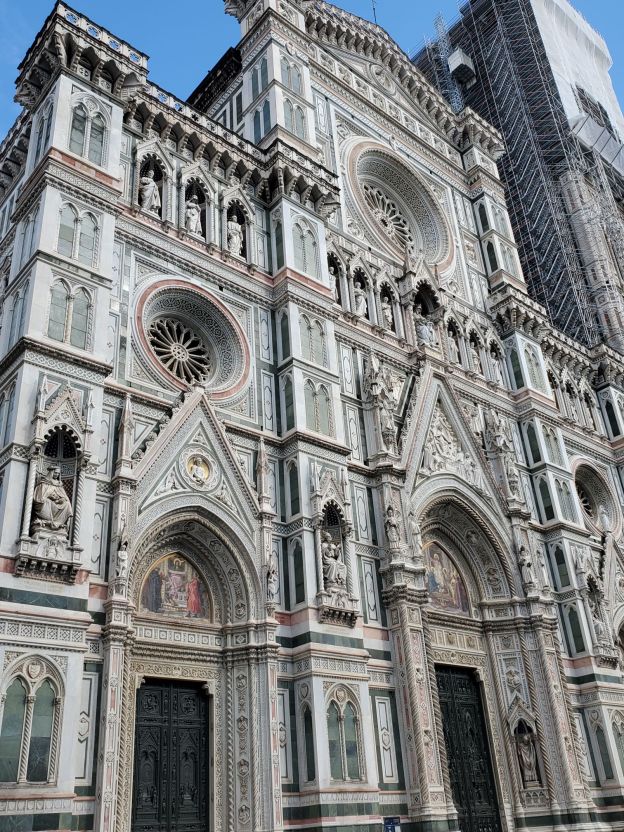
On a recent short visit to Florence, I was struck once again by the astonishing attention to detail which the craftsmen of the Renaissance brought to their labours – there are details in stonework, in mosaic and painting, which for centuries have been invisible to the naked eye of those walking about in the street below. So why bother going to all those lengths to create beauty which remains unseen? Why?! Because the creative instinct was driving an act of worship, and reflecting the truth that all we do is seen by our Father in heaven, and ultimately it is only his favour which matters. I love the idea of those master masons, and all the other trades and crafts pondering how best to create beauty in inaccessible corners, knowing that their delight in what was made would be shared by their Father in heaven!
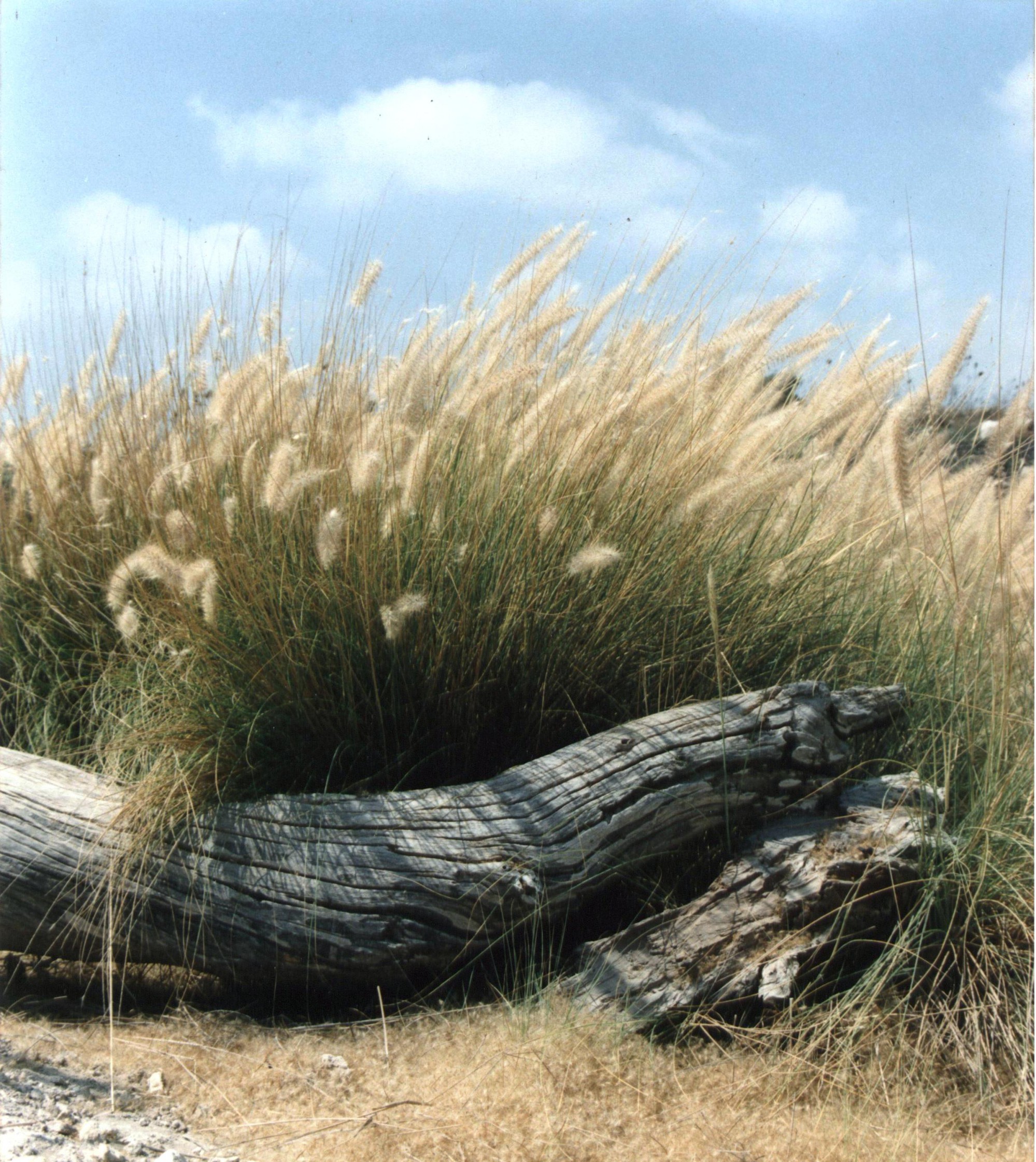
Consider for a moment how much beauty exists in the world which we never see – how ridiculous it is then to assume that unless the human eye rests upon and approves it, there is no ‘point’ in that glorious moment! All of creation shouts praise to God, and he delights to receive that praise, from animate and inanimate, from the greatest movements of galaxies, down to the still unknown (to humanity) secrets of physics, biology and geology.
Our God-of-abundance has made more than we can imagine, more than we can ever see in our lifetimes, and all is made to speak of his divine nature and glorious power. I am thrilled to know that I can share that revelation as I seek to live with Jesus day-by-day, praying that God’s likeness might be revealed in my making and my loving, in my being, and that – with all creation – I might glorify my Maker, and enjoy knowing and being known by him into eternity.
“I came to see that the human imagination is not paramount in the creative process: that what is paramount is “The Creation” and He who created it and that what the true artist is expressing is not himself but his response to this eternal continuing process of Creation… I believe that, in the humblest way, we are collaborators on earth in God’s continuing act of Creation, and that this is the role of the artist in society.”
(Hew M Lorimer OBE, 1907-1993, Royal Scottish Academician, sculptor)



 aforgetfulsoul