Category Archives: wisdom

It’s not my job….

A discerning person keeps wisdom in view, but a fool’s eyes wander to the ends of the earth.

A person’s steps are directed by the Lord. How then can anyone understand their own way?

There is no wisdom, no insight, no plan that can succeed against the Lord

(Pr 17.24; 20.24)

Since no one knows the future, who can tell someone else what is to come?..When I applied my mind to know wisdom and to observe the labour that is done on earth..then I saw all that God has done. No one can comprehend what goes on under the sun. Despite all their efforts to search it out, no one can discover its meaning. Even if the wise claim they know, they cannot really comprehend it.

(Eccl 8.7,16&17)

The arrogance of man will be brought low and human pride humbled; the Lord alone will be exalted in that day, and the idols will totally disappear….Stop trusting in mere humans, who have but a breath in their nostrils. Why hold them in esteem?

(Isa 2.17&22)

Then Jesus said to his disciples: “Therefore I tell you, do not worry about your life, what you will eat; or about your body, what you will wear..Who of you by worrying can add a single hour to your life? Since you cannot do this very little thing, why do you worry about the rest?….do not set your heart on what you will eat or drink, do not worry about it…your Father knows that you need them. But seek his kingdom, and these things will be given to you as well..

(Lk 12.22,25,29-31)

We are called to live in exceptional days, placed here for this time and purpose by God who holds all time and space in his hands and is at work to bring all things to their completion in Christ. The bible narrative encourages believers to continually consider what God has done, and to remember that all that happens is part of his great redemptive plan – each detail of our lives has a place, and in his hand nothing is wasted.

To me, the global experience of pandemic illness has been such a graphic demonstration of the truth which lies behind that instruction of Christ to his disciples – all our worrying achieves nothing, and our job is to trust God and instead look to our role in his work here and now. In the face of this ‘plague’, where governments, armies, wealth and privilege are powerless to  defeat an invisible enemy, we see most clearly that humanity is not in control, cannot be trusted for ultimate security, and must fail. We see our limitations written in the statistics of deaths, in the as yet unseen economic costs, the long term social costs, of this extraordinary time.

A discerning person looks to wisdom – which in the bible is described as the fear or proper respect of the Lord – rather than scanning all the range of human achievement in search of meaning and solutions. When we rightly fear God, recognising that we are mortal, limited and flawed while he is holy, almighty, just and good, then we regain some perspective on all that happens in the world. We STOP thinking that it is our job to fix things, or even to understand why they are happening. We ARE NOT GOD – and what a relief that is! When there is so much pain and suffering to be borne, who could be sufficient for this? Only the Lord Almighty, whose thoughts are emphatically not our thoughts, but whose love can be utterly depended upon.

So in these days, I rejoice that it is not my God-appointed task to find the reason for this pandemic – or any other source of suffering. I give thanks that I can trust God through all my unanswered questions, and instead ask what my job is. While mankind is not meant to know the answers to “Why?”, we are incredibly gifted in finding out “How?”, and so I give thanks and do what I can to support the efforts to address the consequences of the virus – in prayer, in financial and practical support, and by obeying the instructions of our own government.

I pray that God will be at work to fulfill his own mysterious purposes, and that along the way, we will see God’s love in action as people care for one another; as churches reach out in new ways to show Christ; as scientists race to find vaccines and medical professionals put their lives on the line to save others. God will do all that he plans through this great trial…will I do what he asks me to do?

He has shown you, O mortal, what is good. And what does the Lord require of you? To act justly and to love mercy and to walk humbly with your God (Micah 6.8)

In caring, praying, speaking and acting, may I do what the Lord requires of me in these days, and may I be given grace to let God be God, to leave the unanswered questions at the foot of the cross, where the blood of Christ silences them.

Following…who?

Blessed is the man who does not walk in the counsel of the wicked or stand in the way of sinners or sit in the seat of mockers. But his delight is in the law of the Lord, and on his law he meditates day and night. He is like a tree planted by streams of water, which yields its fruit in season and whose leaf does not wither.

(Ps 1.1-3)

Watch out for false prophets..By their fruit you will recognise them. Do people pick grapes from thornbushes, or figs from thistles? Likewise every good tree bears good fruit, but a bad tree bears bad fruit. 

(Matt 7.16&17)

As I urged you…stay there in Ephesus so that you may command certain men not to teach false doctrines any longer…these promote controversies rather than God’s work – which is by faith. The goal of this command is love, which comes from a pure heart and a good conscience and a sincere faith. Some have wandered away from these and turned to meaningless talk. They want to be teachers of the law, but they do not know what they are talking about…

(1 Tim 1.3-7)

If you point these things out …you will be a good minister of Christ Jesus..train yourself to be godly. For physical training is of some value, but godliness has value for all things, holding promise for both the present life and the life to come.

(1 Tim 4.6-8)

The goal of God’s work in his children’s lives is their godliness, the creation of an ever clearer reflection of himself in them, showing his glory and beauty to the world. In the same way that a silversmith purifies the metal by fire, burning off impurities until he sees his face reflected in the liquid metal surface, so also our God is working out his good purposes in us.

We can choose to cooperate with this work, to embrace our destiny with faith and hope, trusting in God to be at work in all things, and seeking to learn in every situation what his will is for us. We can choose to hunger for godliness, choose to yearn after the fruit of the spirit above all worldly ambitions and make every effort to reject those things which frustrate our fruitfulness. The psalmist celebrates the power of the word of God to grow us into fruitful disciples, and when we meditate on it – chew it over, consider it from many angles, allow it to shape our thoughts – we are transformed indeed.

But we also make choices about what kind of people we admire and emulate, whose advice we take seriously and whose lives are our example. It is about choosing such people wisely that Jesus teaches when he speaks of looking for grapes on thornbushes! It is good to have role models, but what qualities should I look for?

Firstly, I need to find people who at least claim to believe that Jesus is the Son of God, our sacrificial Lamb, the Risen and returning Judge – a tree that looks like one which ought to bear good fruit. Secondly, I need to consider what fruit their lives actually bear, since this may give the lie to their claims. Paul warns Timothy about those who claim to be christians, but who bear bad fruit in disputes, divisions, doubts and pointless speculation. The effect of their ministry is not growing godliness – in themselves or their hearers – and this is a sure sign that they cannot be trusted.

So if I am looking to be inspired and encouraged by others in my journey of faith, I need to find those who bear good fruit after the manner described by Paul – lives of godliness, showing peace and self-control, faithfulness and patience, love, joy and kindness. It may well be that those qualities are in lives which are small and quiet in the eyes of the world, and even those considered foolish – so be it, these are the things which I desire. Let me learn humbly and reverently from God’s servants wherever they may be found, recognising in them a means by which I may be drawn further into godliness.

It is also good to find teachers who can educate us in the things of God, and we can serve them in praying for their protection – the history of the church is littered with sad tales of prominent saints who were led astray, and whose status proved a temptation to which they seemed to have no defences. We are all vulnerable and none should judge another for falling, but rather pray God’s keeping from sin and deliverance from temptation for ourselves and all those called into public service for the gospel.

Lord God, I thank you for all those who teach and lead me in your ways. Keep us all from sin, and make us quick to run to you when tempted to go astray. Keep your name in honour among us, that we might above all things fear bringing it into disrepute, and strive with all our might to be found increasingly in the image of Christ. For your glory and our blessing we pray, Amen!

What are my priorities?

Therefore, I urge you, brothers, in view of God’s mercy, to offer your bodies as living sacrifices, holy and pleasing to God – this is your reasonable act of worship.

(Rom 12. 1)

Don’t you know that you yourselves are God’s temple and that God’s spirit lives in you?.. Do you not know that your body is a temple of the Holy Spirit who is in you, whom you have received from God? You are not your own; you were bought at a price. Therefore honour God with your body..

(1 Cor 3.16 &6.19&20


So then, just as you received Christ Jesus as Lord, continue to live in him, rooted and built up in him, strengthened in the faith as you were taught, and overflowing with thankfulness. See to it that no one takes you captive through hollow and deceptive philosophy, which depends on human tradition and the basic principles of this world rather than on Christ…..Since you died with Christ to the basic principles of this world, why, as though you still belonged to it, do you submit to its rules?…These are all destined to perish with use, because they are based on human commands and teachings. Such regulations indeed have an appearance of wisdom, with their self-imposed worship, their false humility and their harsh treatment of the body, but they lack any value in restraining sensual indulgence…

(Col 2.6-8,20-23)

There are many socially acceptable ‘sins’ which we tend to gloss over when we encounter them, and justify to ourselves in order to indulge in them – and there is a significant word…”indulge”. How ready we are to listen to the philosophies of the world which encourage us to ‘treat ourselves well’, to prioritise ‘self-care’ and make sure that all our needs are being met so that we can take care of others and fulfill our mission in life.

It is all plausible, and in some ways attractive and compatible with the gospel, with God’s love for us and his plans to do good for and through us. BUT, I become very uneasy with it, all too aware that we use this to justify behaviour which the bible would bluntly describe as shameful for one who professes to be a disciple of Jesus.

At what point does my proper desire to look after the body which God has given me tip over into idolatry? What do my habits of consumption mean for those around me – am I setting a good example of self-discipline, or encouraging others in slothfulness and greed – or the opposite evils of obsessive control over food and weight? I try to keep fit, to ensure that I am functioning well and able to do the tasks allotted to me and not burden my family with caring for me in preventable illnesses. But, I must not let that become a lifestyle based on the conviction that if I will eat/exercise etc in certain ways, then I can somehow avoid every ailment and attain long, healthy life! The Lord alone knows the span of my days, and having lost both parents relatively young to cancer, I know full well that healthy living doesn’t guarantee longevity.

Paul speaks many times of the sufferings he went through as a servant of Christ – he also speaks of living in a focussed way, of keeping himself ‘in training’ for the race of his life of service. He speaks of being content in every situation – that speaks of a mind and heart which rests in God, not in its own controlling routines of food and exercise. He knew how to enjoy the good things of life, but also how to keep all things in right relation to the priority which was his commitment to Christ and the spreading of the gospel. I wonder how Paul would react to the phrase “self-care”?! Not positively I suspect, and mainly because of the presence of the word “self”, which should sound alarm bells for every believer who has entrusted themselves to Christ, believing that he alone is the source of our security, purpose, and the only one who can meet all our needs. My focus must be on him, not on myself…

There is clearly a balance to achieve; and we are not called to neglect ourselves either – Paul exhorts young Timothy to look after his health, and we too should not be irresponsible. But the emphasis must be on this, that I am not my own boss anymore. All that I am and have is a gift from God, and is surrendered to his service when I confess Christ as Lord of my life. He bought me with his blood, and in loving response, I seek to use all that I am in his service, seeking only his approval and his direction.

May God help us to live joyfully, in whatever circumstances are allotted to us; using our bodies responsibly and honouring him as we do so, so that we might indeed – with Paul – complete our race and win the only prize that matters, when our Lord says, “Well done, good and faithful servant!”


The fruit of the spirit is….self-control

When I am afraid, I will trust in you. In God, whose word I praise, in God I trust; I will not be afraid.

(Ps 56.3&4)

I will sing of your love and justice; to you, O Lord, I will sing praise. I will be careful to lead a blameless life – when will you come to me? I will walk in my house with blameless heart. I will set before my eyes no vile thing..My eyes will be on the faithful in the land, that they may dwell with me; he whose walk is blameless will minister to me.

(Ps 101.1-3,6)

You are my portion, O Lord; I have promised to obey your words. I have sought your face with all my heart; be gracious to me according to your promise. I have considered my ways and have turned my steps to your statutes. I will hasten and not delay to obey your commands. though the wicked bind me with ropes, I will not forget your law. 

(Ps 119.57-61)

Do not let your hearts be troubled. Trust in God, trust also in me…

(Jn 14.1)

May the God of hope fill you with all joy and peace as you trust in him, so that you may overflow with hope by the power of the Holy Spirit

(Rom 15.13)

It is easy to think of self-control as a quality of restraint, of holding back and NOT doing those things which might be harmful or otherwise ungodly – for us and for others. But there is also a proactive quality, the ability to steel oneself to do right things – even if they are hard, making us apprehensive of rejection and conflict.

In his final address which is recorded by John, Jesus commands his disciples not to let their hearts be troubled – and they go on to express profound uneasiness and trouble in the following verses! But when I read the words recently, I was struck by this element of command – do not ‘let’ your hearts be troubled…and the subsequent ‘trust in God’

Jesus speaks as though by actively pursuing trust, we can also actively obey the command to keep our hearts untroubled, no matter what we are facing. This can only be achieved by the power of the Spirit in us, reminding us of the promises of Jesus, of the riches of God’s love and provision for us, and above all, showing us that we are part of a great and glorious plan which is fully under God’s sovereign control. When we can trust that God is working all things together for his glory and our blessing, then our heart-troubles subside and we find peace.

This isn’t about some supreme teeth-gritted, fist-clenched effort which we have to make, but rather a steady cultivation of our thoughts and attitudes; a learning to trust first. When the spirit of Jesus within us is active, when we are working with him to feed our minds with the word of God, we are choosing to believe that word is doing us good. When we exercise self-control to make sure that our spiritual nourishment is not neglected, by meeting to pray with others, by worshipping together and hearing from the word, then we are giving ourselves the equipment we need to trust God, in all that may come to us.

We will undoubtedly face circumstances every day which will challenge the tranquility of our hearts – we live in a world which is so broken by sin and evil that it is impossible to avoid trouble, whether from within or without. But we can choose what we do with those troublings…either we put up no defence, and allow them to take up residence in our hearts and minds, dictating that we are driven by fear and anxiety; or we exercise the self-control which the spirit enables within us.

We choose to remember God’s promises; we choose to trust that he is good, and true and loving, and powerful; we bring our fears and troubles to him, and choose not to dwell on them. This is not self-hypnosis, but faith in action. By actively pursuing trust in the God who has revealed himself as supremely loving, and intimately caring towards us, we learn to stand secure amidst troubling circumstances – not because nothing bad may happen, but because God is in control of everything for his glory and our blessing


Words, words, words!

How sweet are your words to my taste, sweeter than honey to my mouth…Your word is a lamp to my feet and a light for my path….I have suffered much, preserve my life, O Lord, according to your word…Your statutes are my heritage for ever; they are the joy of my heart. My heart is set on keeping your decrees to the very end…You are my refuge and my shield; I have put my hope in your word…

Sustain me according to your promise, and I shall live; do not let my hopes be dashed….Ensure your servant’s well being; let not the arrogant oppress me….Turn to me and have mercy on me, as you always do to those who love your name. Direct my footsteps according to your word; let no sin rule over me. Redeem me from the oppression of men, that I may obey your precepts. Make your face shine upon your servant and teach me your decrees. Streams of tears flow from my eyes, for your law is not obeyed.

(Psalm 119, taken from 103-136)

All scripture is God-breathed and is useful for teaching, rebuking, correcting and training in righteousness, so that the man of God may be thoroughly equipped for every good work.

(2Tim.3.16&17)

For the word of God is living and active. Sharper than any double-edged sword, it penetrates even to dividing soul and spirit, joints and marrow; it judges the thoughts and attitudes of the heart. Nothing in all creation is hidden from God’s sight. Everything is uncovered and laid bare before the eyes of him to whom we must give account.

(Heb.4.12&13)

Do you ever consider how wonderful it is that the words contained in our scriptures – old and new testaments, dating back over thousands of years – continue to be the foundation of living faith and hope in God, for people all around the world? These words, God-breathed as we believe, and coloured with the characters and gifts of the human authors, are as potent in 2018 as they were in 500, or 1050, to transform lives and bring people on their knees before God in repentance and faith. What a wonderful message is contained within them, what incredible power is made available through them, what a marvellous privilege is ours to be able to handle and read them for ourselves!

And they are a personal word; we hear the voices of the authors with such power as they bring their distinctive gifts and situations to bear on their writing. There is no such things as a ‘standard’ book in the bible, and even within broad groupings, there is rich variety – from the eloquence of Isaiah, to the brief and potent message of Micah; from the personal narratives of Ruth and Esther, to the detailed histories of Chronicles and Kings. The psalms themselves contain every human emotion, brought and laid bare before the throne of mercy, the only safe place for us to unveil our deepest thoughts and the only place to unburden ourselves of all desire for revenge, all our depths of despair, all the unfulfilled longings of our hearts..What a great treasure trove; surely as Paul wrote to Timothy, with this we can be fully equipped for the work and walk to which God has called us.

Our God is not constrained by culture, race or historical era, and his words are as powerful now in China and Chile as they were in ancient Colossae, or Corinth. Disciples today are learning from the suffering of Job and the lamentations of Jeremiah on the judgement of his people, just as the early church did when they faced persecution and death.

It is this fact, the “living” quality of God’s word to us, which lies behind the continuing drive to translate the scriptures into languages which may not even yet have their own alphabet, let alone books. It is this which allows missionaries to preach Christ with confidence in every nation, tribe and tongue, trusting scripture to speak as powerfully to new converts in 21st century Chad or Myanmar as it did in Philippi and Rome.

Let us praise God for his infinite wisdom and power in the gift of his word; let us rejoice in all the ways in which we have and continue to benefit from it – not taking the freedom to own, read and share the word for granted! May the example of the author of Psalm 119 inspire us to praise and celebrate the glory of God as revealed in his word. It is surely the foundation for our witness, our wisdom and our worship; it is sweeter than honey to our lips, and more precious than gold; light to our path and joy to our hearts. Let us, with the psalmist, treasure it and seek ever more faithfully to live by it.

Never stop learning!

Instruct the wise and they will be wiser still; teach the righteous and they will add to their learning. The fear of the Lord is the beginning of wisdom, and knowledge of the Holy One is understanding.

(Prov 9.9&10)

Teach me, Lord, the way of your decrees, that I may follow it to the end. Give me understanding, so that I may keep your law and obey it with all my heart…Teach me knowledge and good judgement, for I trust your commands…It was good for me to be afflicted so that I might learn your decrees…Your statutes are my heritage for ever; they are the joy of my heart. My heart is set on keeping your decrees to the very end.

(Ps 119.33,34,66,71,111,112)

For the word of God is alive and active. Sharper than any double-edged sword, it penetrates even to dividing soul and spirit, joints and marrow; it judges the thoughts and attitudes of the heart. Nothing in all creation is hidden from God’s sight. Everything is uncovered and laid bare before the eyes of him to whom we must give account.

(Heb.4.12&13)

I was greatly blessed recently by the presence in our home of two of the brightest saints I know, whose company is always a joy and encouragement, and whose zest for life and the service of their Saviour is unquenchable. It was an honour, but also a very humbling experience, to see their strength in the Lord’s service, their zeal for his glory, and their vigour. They would claim no special talents, but only boast of the wonderful God who has enabled them for a lifetime of service – on the mission field in Africa, and here in Scotland – which continues in their “retirement”, with a schedule that would leave many of us gasping.

In the course of one of our many conversations, we touched on the importance of having a “teachable spirit”, and by that we did not mean being one who pursues learning for the sake of head-knowledge, but rather the one who is always aware that they are not yet what God desires them to be, and that there is always something to learn. The verse from Proverbs puts it beautifully, showing that wisdom can ALWAYS be added to, and that those who truly seek to grow in godliness will find God willing to teach them. Those who fear the Lord, will truly make it their aim to be life-long learners, pursuing to the very end of their days a deeper understanding of his word and of how he desires us to live.

There are perhaps two distinct kinds of wisdom in view here. Firstly, that which we direct ourselves, through our choices in reading, listening and watching. As followers of Christ, we can choose to engage with the bible in a way that helps us to understand deep truth, to wrestle with moral and ethical issues in the light of its teaching, so that our witness will be informed, humble and truthful. This is where conscious choice operates, perhaps based on events around us, or on topics which have arisen in conversation or in a sermon.

The other kind of wisdom is directed by our own circumstances, or those of our loved ones, where we have little or no control over events and cannot forsee where they are taking us. When the psalmist writes that it was “good for me to be afflicted so that I might learn your decrees”, he is touching on a mysterious truth. Human beings learn faith best under adverse circumstances; our pain and suffering drive us beyond our own resources to admit that we are not in control and to cling to God for strength and aid in our extremity of need.

My visitors have known both kinds of learning, and their lives testify that they continue to seek after God’s truth both in their deliberate study of his word and also as they experience trials of many kinds. It takes humility to admit that after decades of following Christ, one still has things to learn, and that is what we meant by that phrase a “teachable spirit”. Do I have it?…

When I find myself impatient with the failings of others….Lord, forgive me, and grant that I might learn your patience, because you have not given up on me;

When I find myself confident in a human being, trusting in an organisation and a structure……Lord, forgive me, and grant that I might learn that all men are as grass, frail and fallible and none may be truly relied upon save you alone;

When I find myself despairing of my own failings…..Lord, forgive me, and grant that I might learn to live in the light of your promises, resting on the assurance of your putting away of all my guilt through the death of Jesus for me;

When I become proud, and independent….Lord, forgive me, bring me back to utter dependence on you and grant that I might learn to walk ever more closely with you.

When there seems to be no “right” way..

Do good to your servant according to your word, O Lord. Teach me knowledge and good judgement, for I believe in your commands…I have kept my feet from every evil path so that I might obey your word. I have not departed from your laws, for you yourself have taught me. How sweet are your words to my taste, sweeter than honey to my mouth! I gain understanding from your precepts; therefore I hate every wrong path. Your word is a lamp to my feet and a light to my path..

(Ps 119. 65&66, 101-105)

Be very careful, then, how you live – not as unwise but as wise, making the most of every opportunity, because the days are evil. Therefore do not be foolish, but understand what the Lord’s will is.

(Eph 5.15-17)

I believe that since I have confessed Jesus as Lord, and since I depend solely on his death on the cross for my salvation and acceptance in God’s eyes, I am assured of my position as a beloved, redeemed and secure child of God. I have a heavenly Father who delights in me, who forgives me and bears with me, and whose plan is all for my blessing and his glory. He is at work daily, by his spirit within me, through his word and all the circumstances of my life, to cleanse and purify and also to use me to bless others. I desire with all my heart to co-operate with this work – to be a blessing, and to know myself transformed, made like Christ.

BUT…I also believe that each of us starts with our own particular temperaments, strengths and weaknesses. Things which others may struggle with, may pass me by. While things which bring me to my knees in fear or catch me unawares over and over again will not trouble my friends at all! It is so important not to judge ourselves by other people’s lives, but to try and look only to our Father for approval and acceptance. In the meantime, I am wrestling once again with an issue which has troubled me all my life…knowing (in any given situation) what is the RIGHT thing to do.

Let me make it clear. There are obviously situations in which we choose between sin and holiness, between obeying a clear command and disobeying it. I am not talking about those, because there the issue is temptation or weariness and weakness. I am concerned with how I discern what action to take, what attitude to cultivate, when the choice is between a number of equally likely or appropriate alternatives! In other words, a choice between varieties of obedience!

On the one hand, I believe in a sovereign God, who directs my life according to his perfect will – miraculously working all things together for his glory and my blessing. That should mean that I can trust him to use whatever choices I make…and yet somehow I still feel a dreadful burden of responsibility – I don’t want to be the child who goes off down dead-ends and has to be retrieved at great effort, when another choice would – with hindsight – have been better. Is it pride that underlies the whole thing? Perhaps it is, the pride that hates to make mistakes, to cause disappointment, and to put others to trouble to sort out the mess.

I remember a minister talking about “sanctified common sense”, and what he meant was that our ability to make rational and sensible decisions is just as much affected by our ongoing transformation into Christ-likeness as the rest of us. We are gifted with this sense of what is wise – an inner balance which puts ‘pros’ on one side and ‘cons’ on the other, and looks at the result. As a follower of Jesus, I should be able to trust this sense, because it is more and more informed by his word and guided by his spirit. The things which weigh in the balance will be the things which matter to him – like stewardship of my gifts, love to my neighbour, obedience to his word, serving his mission in the world.

So as I look to the next big question, the choice between equally valid options, I will be praying for that wisdom which comes from my saviour’s transforming of my mind, and for the trust that will enable me to act upon my decision without fretting that I have somehow gone wrong!! Praise God that he IS big enough, merciful and loving enough to work everything together for good, and for his patience with a dithering, over-thinking anxious child like me….

How shall they hear?

The longer Paul waited in Athens for Silas and Timothy, the angrier he got – all those idols! The city was a junkyard of idols….”It is plain to see that you Athenians takeyour religion seriously. When I arrived here the other day, I was fascinated with all the shrines I came across. And then I found one inscribed, TO THE GOD NOBODY KNOWS. I’m here to introduce you to this God so you can worship intelligently, know who you’re dealing with.

(Acts17)

This is the core of our preaching. Say the welcoming word to God – “Jesus is my Master” – embracing, body and soul, God’s work of doing in us what he did in raising Jesus from the dead. That’s it. You’re not “doing” anything; you’re simply calling out to God, trusting him to do it for you. That’s salvation…It’s exactly the same no matter what a person’s religious background may be: the same God for all of us, acting the same incredibly generous way to everyone who calls out for help….but how can people call for help if they don’t know who to trust? And how can they know who to trust if they haven’t heard of the One who can be trusted? And how can they hear if  nobody tells them?

(Romans 10)

Be ready to speak up and tell anyone who asks why you’re living the way you are, and always with the utmost courtesy.

(1Peter 3)

All from The Message – the New Testament in contemporary language

When Paul stood up in the Areopagus in Athens, to direct the attention of this diverse and intelligently curious people to the ‘unknown god’ whom they worshipped, he faced a major challenge. Which language should he use?

As a Pharisee – a teacher of the Jewish law – he was skilled in using all the technical language which grows up around faith and the literature on which that faith is built. The terminology was second nature to him, and he was adept in drawing on scripture for his arguments. In his new life as an apostle, and a church-planter and teacher, these skills were hugely significant, equipping him to articulate and elucidate all the implications of the coming of Jesus Christ as the long- awaited Messiah.

But as he moved further from Jerusalem, and as the Holy Spirit moved him further from Jewish populations, he had to articulate and teach faith to people who had no background in the books and culture of Judaism, and no family history of observance to inform their understanding. Paul had to learn new ways to communicate this world-changing faith, this good news about Jesus Christ, which would be understood by people of completely different religious backgrounds. His speech to the Athenians as recorded in Acts 17 is one such attempt, and is often cited as a model for evangelistic addresses in places where there is no history of christian faith (and he didn’t hesitate to call for repentance in light of coming judgement!)

In studying this passage with folk at church recently, we agreed that in order to effectively share our faith with our neighbours – a thing we agree is right – we need to purge our speech of all the technical jargon which followers of Jesus tend to adopt. We need to have thought clearly about what is meant by salvation, about the incarnation and the divinity of Jesus, about resurrection and sanctification – all these big words which we use so lightly!

It can be helpful to read regularly in versions of the bible such as the Message, because they use contemporary language for complex concepts, and we learn how to express ourselves in the words of daily life when sharing our faith. I was challenged by this study, to think how readily I talk in an almost coded ‘faith-speak’ which would be incomprehensible to a person without a long experience of the bible. In the same way that I lack the knowledge to ‘read’ ancient religious mosaics, so my hearers will fail to understand me. I may well be speaking truth, but the message isn’t getting through!

If I am serious about sharing the good news of a new start in life, a real healing for brokenness and hope for the future, then for the sake of my neighbours, I need to put in the work and learn to talk simply and courteously about Jesus.

How shall they come to faith in God, if no one tells them about him? And if the words I use, and the life I live is too remote from their experience of daily life, then they will not hear, no matter how earnestly I speak to them.

May I become in this more like Jesus, who lived among us, full of grace and truth, and in his words and actions, spoke directly to the hearts of his hearers.

Keep me hungry Lord..

I seek you with all my heart; do not let me stray from your commands. I have hidden your word in my heart that I might not sin against you. Praise be to you, O Lord; teach me your decrees. With my lips I recount all the laws that come from your mouth. I rejoice in following your statutes as one rejoices in great riches. I meditate on your precepts and consider your ways. I delight in your decrees; I will not neglect your word.

(Psalm 119.10-16)

Do your best to present yourself to God as one approved, a workman who does not need to be ashamed and who correctly handles the word of truth.

All scripture is God-breathed and is useful for teaching, rebuking, correcting and training in righteousness, so that the man or woman of God may be thoroughly equipped for every good work.

(2 Timothy 2.15 & 3.16)

Let the peace of Christ rule in your hearts, since as members of one body you were called to peace. And be thankful. Let the word of Christ dwell in you richly as you teach and admonish one another with all wisdom, and as you sing psalms, hymns and spiritual songs with gratitude in your hearts to God.

(Colossians 3.15-16)

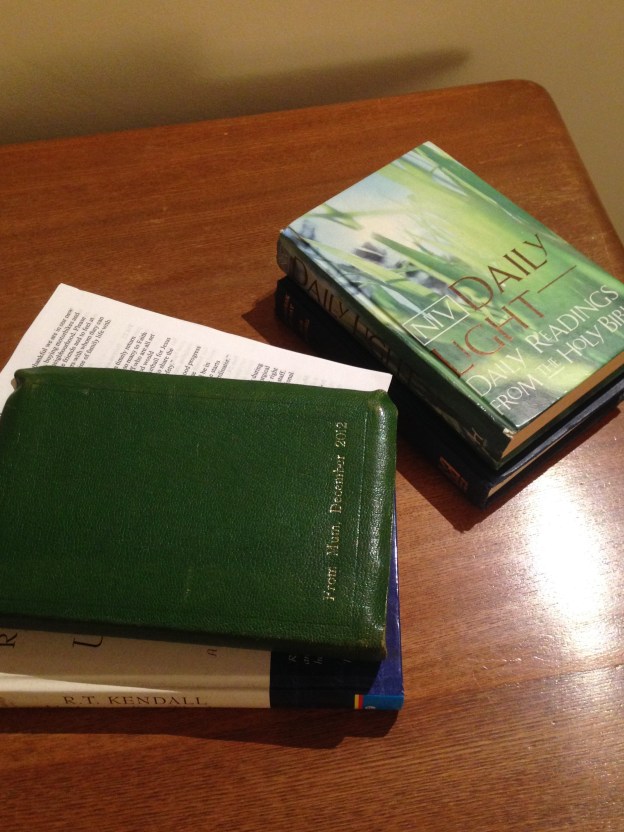
I was always taught that it was important for a follower of Jesus to set aside time daily to pray and read the bible – and I suspect most of us know that it is a good habit to acquire, although we may struggle to establish it! We know in our heads that God speaks to us through the words of the old and new testaments, and that through them, we grow in our understanding of God’s plan for redemption and above all in knowledge of Christ Jesus our saviour.

But how often as human beings do we put into practice things which we know to be good for us?! It is an ongoing struggle for me to find ways to engage with the bible which do not become a rushed, cursory skimming of the text, and perhaps a slightly less rushed perusal of the commentary provided by printed or online notes.. I am almost too familiar with the bible, taking it for granted and assuming that I know enough to get by without trying too hard to improve and continually refresh my knowledge.

I do not believe that there is a one-size-fits-all solution to this challenge, nor even that what suits at one time of life will be appropriate at another. The single mother, caring for children and holding down a full-time job  will find it hard to make time for in-depth daily study – and her Lord knows and understands. A short dose of scripture morning and night might prove as effective and nourishing to her faith as anything more ambitious, because the Holy spirit will use that to speak to her need. Someone who learns better by hearing and seeing than by reading, will find recorded talks and short video clips stimulate their understanding, and prompt their worship and praise just as effectively as prolonged meditation on the complexities of the book of Romans!

The point is, as Paul writes to the Colossians – that the word should “dwell richly” in us, a beautiful expression which I take to mean that it ought to be treasured, to be alive in us, like a welcome presence, influencing every part of our lives. The great 119th psalm is an incredible outpouring of praise for the word, for the treasure which we have in it, and a reminder that it is only as we live by the word that we are in fellowship with God.

Paul writes to encourage the young church leader, Timothy, to work diligently at his knowledge of scripture, so that he can bless others through his teaching and life. We too, have a responsibility to one another to be as skillful in handling scripture as we can be, so that the body of Christ – the church – nurtures and comforts and grows stronger in unity as we teach one another.

When I consider my daily time of bible reading in the light of these thoughts, it is a good deal easier to motivate myself to do it! I am helping others, not just myself, and fulfilling my calling as a member of the church. Through the bible, I see Christ, and he is the end, the purpose of all my studies – to see and know and grow more like him.

May God in his mercy increase my hunger and longing to see Christ, my desire to live with and for him, so that I never grow tired of reading his word and so that it will indeed dwell richly and bear fruit in my life, and be a blessing to those around me.


A gentle prod in the right direction..

So the Lord must wait for you to come to him so he can show you his love and compassion, for the Lord is a faithful God. Blessed are those who wait for his help.

O people of Zion, who live in Jerusalem, you will weep no more. He will be gracious if you ask for help. He will surely respond to the sound of your cries. Though the Lord gave you adversity for food and suffering for drink, he will still be with you to teach you. ..Your own ears will hear him. Right behind you a voice will say, “This is the way you should go,” whether to the right or the left.

(Isaiah. 30.18-21)

If you need wisdom, ask our generous God, and he will give it to you He will not rebuke you for asking. But when you ask him, be sure that your faith is in God alone.

(James 1.5&6)

I believe in a God who promises to guide and direct his children; a God who desires their ultimate good, which may lead through times of trial and suffering as well as times of ease, comfort and plenty.

I have experienced in my own life these last 18 months, the clear directing of that loving hand, as my husband and I were invited to consider this new place of ministry, and one by one, the objections fell away, and the doors opened even before we pushed them! As the days and months go by, we are deeply at peace here, absolutely convinced that God desires us to work and live in this remote place, within a small community, things we have never done before. He called, and He is enabling, generously!

On a personal level however, I am still seeking guidance and direction, since I am not the parish minister, only his backup team, and that is not a full-time job! I do not know yet, just what my life here is to consist of – whether paid employment alongside housekeeping and church work; or a small mosaic of voluntary occupations, serving as well as I can. I am waiting..a recent job application led to a clearly closed door – an answer of sorts for the moment.. and I wait.

I am getting to know people, using my own interests and things which bring me joy to make connections which might grow into relationships within which I can share Christ. But these are quite selfish ways to use my time, and it has been pointed out to me quite forcefully, that the relationships are principally with folk my own age or older, not the younger members of the community..

There are many good things which need to be done – both church and community based – but I don’t think awareness of a need constitutes a call that I should fulfill it – God knows that none of us can stretch that thinly. How am I to discern what to do? I follow the advice of James, the ever practical apostle, and ask – and keep asking, not only for guidance, but that I might recognise it when it comes! I wait, trying to use my time well, but not committing to anything permanently, testing out the different opportunities and asking for that voice to speak clearly.

Father God, your child is  stumbling a little; unsure of her footing and of the way, she looks for your hand and strains to hear your voice: Fulfill your promise and guide her.

Lord God, the God of Abraham, Isaac and Jacob: you spoke to your children so clearly at times, directed their ways and they knew what to do: Fulfill your promise, and guide this child now.

Delivering God, who confronted Moses in the desert from within the fire, speaking with power and then led your people by fire and cloud up from slavery, fulfill your promise, and lead this child.

You see her heart’s desire is to glorify you; and she longs to know how this is to be done, here, now, in this place; fulfill your promise Lord, and grant her heart’s desire.

Purify her heart and thought of all that would mislead her, tune her ears to hear your voice, strengthen her will that she might obey if the call is to some work which she finds daunting.

Above all Father, so fill her heart with love for her precious Lord, that any labour for him is a privilege, no matter how humble, and any sacrifice of selfish pleasure is worthwhile.

Only let her know that she is doing your will, for the blessing of her community and the glorifying of your Son’s wonderful name.

Amen