
Tag Archives: John 10

When the heart yearns..

You don’t want to hear Him – but He is calling your name.

You don’t want to follow Him – but your life is in His hands.

Your choices are taking you further and further from the fold – but His love is as strong as ever, and you are precious in His sight.

May you be gifted with restlessness; with hunger for more; with the ability to respond and to recognise your emptiness without Him.

May you be brought home before it is too late.

May you be confronted by Christ, even as you turn away from Him, and have no peace until you make peace with Him.

O, child of my heart, come home!

Who is it that you know for whom this blessing is your prayer? A sibling, a parent, a spouse? A friend, or a beloved child? This grief, borne by so many in the world, is a small echo of the heart of our Father, who yearns over all his children, and desires that none should perish apart from His love. It is a grief which we shy away from, preferring to think about other things, praying about other issues, but actually, the salvation of each and every person is God’s desire – and therefore should also matter to us, should touch us deeply. But how much pain lies in this – as yet- unanswered prayer..

The gift of salvation is one which cannot be inherited from our parents, nor caught by proximity and long exposure to other believers. Each person must come to a living and direct relationship with God, by faith in Jesus, if they are to be assured of eternal life and hope. There is no other way, and so this one greatest gift, which we long to see all our dear ones share, remains one which we cannot give them. 

The bible teaches how God offers his love and grace to all who will respond in repentance and faith; and time and again through the Old Testament, the prophets give voice to God’s lament over the stubborn hearts of his people. Beloved children, who turn away from him and who – knowing the truth – seem immune to the love and saving power of the God who woos them so passionately. Did God fail in his love and care? Is that why the people drifted away from him? Merely writing those words jolts me into recognising that the problem does not lie with God, but with the heart of humankind, which so readily settles for less than God’s best for us, and chooses to believe that in some way we can benefit from God’s care without actually caring about him.

As human parents, friends and family members, we have all had opportunities to share the good news with our dear ones; and we know that we have also failed many times to do so – whether in word or deed. To berate ourselves over lost opportunities is fruitless, and also denies God’s grace and forgiveness. But where does that leave us, as believers grieving over lost sheep? Are we responsible for their absence from the fold? In the parable of the lost sheep, Jesus makes no mention of why one animal had gone so far astray, focussing instead on the loving determination of the shepherd to find and rescue it. That comforts me, because it puts the onus on the rescuer, the divine shepherd, to do for the sheep what only he can do, and what he has done in dying to save them. I am only one of the sheep, not the shepherd! 

I am the good shepherd; I know my sheep and my sheep know me – just as the Father knows me and I know the Father – and I lay down my life for the sheep.

(Jn 10.14&15)

What do you think? If a man owns a hundred sheep, and one of them wanders away, will he not leave the ninety-nine on the hills and go to look for the one that wandered off? And if he finds it, I tell you the truth, he is happier about that one sheep than about the ninety-nine that did not wander off. In the same way your Father in heaven is not willing that any of these little ones should be lost.

(Matt 18.12-14)

I have no ready answers to the question of why those raised in the faith should stray from it, hardening their hearts and seeming deaf to the loving call of their shepherd and saviour. I have no glib assurance that our prayers for their salvation will be readily answered. But I do know that my grief over the straying lamb is something that God wants me to feel fully, to carry willingly and prayerfully day by day. This grief – like other pains which we are called to bear – is a spur to prayerful dependence on my Father, for the fulfilment of his will and the display of his glory. 

Dear Father, your heart knows the grief which comes from watching beloved children straying and living without you at the centre of their lives. Thank you that this grief which I am called to carry is not strange to you, and that even as I ache, your love for me is strong and sure, and you call me to bring this burden too and lay it at your feet. Let me love, and pray and trust you for my straying sheep, for my Lord Jesus died for them, and in his name, I pray for them, Amen.

He doesn’t get tired…. ever, even of me!

I lift up my eyes to the mountains: from where will my help come? 

My help is from the Lord, maker of heaven and earth.

He does not let your foot stumble. Your guard does not slumber.

Look, He does not slumber nor does He sleep, Israel’s guard.

The Lord is your guard, the Lord is your shade at your right hand. By day the sun does not strike you, nor the moon by night. The Lord guards you from all harm, He guards your life. The Lord guards your going and your coming, now and forevermore.

(Ps 121, R Alter translation)

For we do not have a high priest who is unable to sympathise with our weaknesses, but we have one who has been tempted in every way, just as we are – yet was without sin. Let us then approach the throne of grace with confidence, so that we may receive mercy and find grace to help us in our time of need.

(Heb 4.15&16)

“I am the good shepherd; I know my sheep and my sheep know me – just as the Father knows me and I know the Father – and I lay down my life for the sheep…… My sheep listen to my voice; I know them and they follow me. I give them eternal life, and they shall never perish; no-one can snatch them out of my hand.”

(Jn 10.14,15,27-29

I think it is impossible for mere mortals to grasp the passionate tenderness with which our heavenly Father loves us, and which our Lord and Shepherd brings to his care for us his flock. We are not equipped to compass such depths and heights of love, and can only glimpse them, catch brief tastes of his delight in us; discern as if from afar the sweetness of his care and the power which he is continually exerting on our behalf. Those tantalising moments are enough though, aren’t they? We are lifted up to mountain tops for a little time, viewing the great glory unrolling all around us, and basking in the love of the eternal as in the rays of the sun.

Our God never fails in his care for his children; never grows tired of hearing their voices, receiving their petitions and sacrificial praise as they bring all that troubles them to his throne of mercy and grace. Our Saviour in glory bears the remembrance of our weakness and mortality, the way our burdens lie so heavy and our horizons shorten abruptly in the face of fear, illness and doubt. He never, ever, ever grows weary of lifting those burdens, wiping our tears and loving us as tenderly as only he can. I find this unbelievably comforting and it inspires me to worship and praise this loyally loving Shepherd, resting in what he has done and who he is for me and for all that is good, true and eternal. And to think that it is as I rest, as I fling my burdens at his feet over and over again, that I am worshipping and bringing him glory – what a marvellous transaction! The thing I most need to do, is the very thing which best honours my dying and rising Lord in all his glory.

Friends, let this truth be our anchor and rock as we face trials – our own, those of our family and friends, and in our wider world. No matter what is going on, the best thing to do is to bring it to the Lord, rush headlong with grief, pain, fear, doubt, weariness, the lead-weight of inexplicable suffering – and lie before him in complete honest abandonment. He will never abandon his lamb, nor spurn the cries of his beloved; he is never asleep on the job, or bored with our presence, but longs that we share it all with him.

This pattern of life doesn’t guarantee that we will see every trial fade away like dew in the warmth of the sun; even now, I can think of faithful believing friends dealing with the suicide of a spouse, the painful death-before-death of a spouse through dementia, the resurgence of cancer, the abrupt curtailing of health and strength by a stroke, the slow debilitating progress of degenerative conditions, the apparently permanent rejection by beloved children of the faith in which they were raised.. and that is before I look to wider social ills and global uncertainties. We do not become believers to become wealthy or secure in the world’s eyes, but to gain eternal life and the sure hope of a glorious future which nothing can steal from us.

For us, to live is Christ, and to die is gain – and since we must face trouble in this world, surely it is good news that we have the unwearying, loving presence of our Lord as we go, and his assurance that we are ever safe with him, no matter what happens. May He give us grace to walk by faith, day-by-day, trusting him completely, for His name’s sake, Amen.

On being shepherded…

You who bring good tidings to Zion, go up on a high mountain. You who bring good tidings to Jerusalem, lift up your voice with a shout, lift it up, do not be afraid; say to the towns of Judah, “Here is your God!” See, the Sovereign Lord comes with power, and his arm rules for him. See, his reward is with him, and his recompense accompanies him. He tends his flock like a shepherd: He gathers the lambs in his arms and carries them close to his heart; he gently leads those that have young.

(Isa 40.9-11)

The Lord is my shepherd, I shall not want.

In grass meadows He makes me lie down, by quiet waters guides me.

My life He brings back. He leads me on pathways of justice for His name’s sake.

Though I walk in the vale of death’s shadow, I fear no harm, for You are with me.

Your rod and staff – it is they that console me.

You set out a table before me in the face of my foes.

You moisten my head with oil, my cup overflows.

Let but goodness and kindness pursue me all the days of my life. And I shall dwell in the house of the Lord for many long days.

(Ps 23 – translation by R. Alter)

Jesus said again, “I tell you.. I am the gate for the sheep… whoever enters through me will be saved…. I am the good shepherd. The good shepherd lays down his life for the sheep… I am the good shepherd; I know my sheep and my sheep know me – just as the Father knows me and I know the Father – and I lay down my life for the sheep”

(Jn 10.7,9,11,14&15)

These are among the most beloved passages of our scriptures, speaking eloquently of the tenderness and care of our God for those whom he calls his ‘flock’. The picture of a shepherd with his sheep was of course very familiar to Jesus’ audience and to the pastoral people for whom David wrote psalms and to whom Isaiah spoke his prophecies. The image was ripe for teaching truths – both about the foolishness of the sheep (us!) and their need for diligent and sometimes sacrificial guarding ; and also about the characteristics of true or good, shepherds. Sometimes it was ‘false’ shepherds who were condemned by the prophets for failing to act as God called them to – those in leadership in Israel who knew the word of God and yet exposed the people to all kinds of dangers through laziness, bad example and outright false teaching.

As with other roles in the Old Testament – king, judge, husband – we come to realise that these are ways of understanding how our God wants us to understand who He is, and what our relationship is with him. He is the sum of the ideal parts of all these roles, and even the best human examples fall far short of his perfection. So it is with the shepherd and his flock.

Today then, let us remember who our Shepherd is, and what it means to be one of his sheep.

The One who stands guard over us is vigilant and strong; he has demonstrated his commitment to us and our safety by dying that we might live. His victory over our ultimate enemy has already been secured, and we have been rescued from a cruel and greedy master into the care of a loving, generous, and faithful shepherd.

He carries the weak and small close to his heart, the road is too rough for them; he takes the flock by paths which will not tax them beyond their capacity, since he knows just how each one is burdened; he makes sure there are places where we may be refreshed on each stage of the journey.

The One who tends us also goes with us, he has made his dwelling among us and chooses to know and be known by us intimately, so that we might have no fear of abandonment even when the path is overshadowed and we cannot see the way.

O Lord, our shepherd, we thank and praise you today for this rich picture of your care for us, and all the ways that you apply it to our hearts and to our hurts. We worship you, our faithful, death-defeating and life-giving shepherd and pray for wisdom to know your voice more clearly, and for the simple trust which enables us to rest in you even in the midst of trouble. 

Holding my line..

“.. listen obediently to God, your God, and keep the commandments and regulations written in this book of revelation. Nothing half-hearted here, you must return to God, your God, totally, heart and soul, holding nothing back… And I command you today: Love God, your God. Walk in his ways. Keep his commandments so that you will live, really live, live exuberantly, blessed by God, your God…

“I call heaven and earth to witness against you today: I place before you life and death, blessing and curse. Choose life… And love God, your God, listening obediently to him, firmly embracing him. Oh yes, he is life itself, a long life…

(Deut 30.10,16,19-20)

Do you hear lady wisdom calling?.. right in the city square where the traffic is thickest, she shouts, “You – I’m talking to all of you.. –  I’m telling you how to live well, I’m telling you how to live at your best.. Blessed the man, blessed the woman, who listens to me, awake and ready for me each morning, alert and responsive as I start my day’s work. When you find me, you find life, real life, to say nothing of God’s good pleasure..”

(Pr 8.1,3,6,32-35)

“I am the good shepherd. I know my own sheep and my own sheep know me. … My sheep recognise my voice. I know them, and  they follow me. I give them real and eternal life.

(Jn 10.13&27)

I am a choral singer – that means I sing with lots of other people, not necessarily at the same time or in the same notes.. one of the most important skills we have to develop is to hold our own lines against others when they are doing totally different things from us! It struck me at a recent rehearsal – where not only the other singers but also the orchestra are doing things that clash horribly with my line of music – that this discipline and skill of both finding and then sticking to my own line is a metaphor for the life of a follower of Jesus in a world of hostility to the gospel.

From the very beginning of the story – when Adam and Eve chose to listen to a different voice, singing a different tune – it has been clear that who we listen to will have huge consequences for us and our eternal wellbeing. By listening to, and acting in agreement with, the voice of the serpent, Eve set in train events which are still being played out today. She and Adam knew the voice of God, and chose to listen to another instead.

God has always given his people freedom to listen to other voices, but if we choose to follow their advice, or stop listening for his voice, then we will be heading for trouble. A singer has to listen to all that is going on, but if they are to hold their own line, there will be certain chords and notes which will give them the cues they need and the support to keep going as the composer intended they should! Do I know where to find those cues among the cacophany of other voices which bombard me all the time, suggesting that God cannot be trusted, that Jesus is a myth, that religion is a private thing and not to be talked of, or that it is dangerous and something to be ashamed of?

Followers of Jesus listen for his voice – we turn to the records of his ministry, to the letters of his disciples, to the Hebrew scriptures from which he quoted and where he saw himself foreshadowed. We listen for his voice in scripture, and we listen hard, so that every tone and characteristic becomes dear and instantly recognisable, no matter what else is going on.

Followers of Jesus also listen for each other – just like the others in my particular section of the choir. We hear one another, we depend on one another’s discerning and ability to hold the tune against others – as a group we are so much better and stronger than on our own. In the same way, I am weakened in my faith-listening if I never do it with others, I make myself so much more vulnerable than I need to be!

Almighty God, give your children the will and the discernment to listen out for and fix upon your voice among all that would distract us. Bless us with companions who desire to listen to you, and who will help us to remain faithful to your tune, your rhythm, your composition for this world and your work in it. Help us, if and when we stumble in our line, to realise quickly that we are astray, and to listen with fresh hunger and desire for you, so that we return to your path and glorify you.

A consuming fire

Aaron’s sons Nadab and Abihu took their censers, put fire in them and added incense; and they offered unauthorised fire before the Lord, contrary to his command. So fire came out from the presence of the Lord and consumed them, and they died before the Lord. Moses then said to Aaron, “This is what the Lord spoke of when he said: ‘Among those who approach me I will show myself holy, in the sight of all the people I will be honoured.'”

(Lev 10.1-3)

“‘For this is what the Sovereign Lord says: I myself will search for my sheep and look after them…I will rescue them from all the places where they were scattered on a day of clouds and darkness…I myself will tend my sheep and make them lie down, declares the Sovereign Lord..'”

(Ezek 34.11,12&16)

“I am the good shepherd. The good shepherd lays down his life for the sheep.

(Jn 10.11)

You have not come to a mountain that can be touched and that is burning with fire; to darkness, gloom and storm…But you have come to Mount Zion, to the heavenly Jerusalem, the city of the living God…. You have come to God, the judge of all men…, to Jesus the mediator of a new covenant, and to the sprinkled blood that speaks a better word than the blood of Abel….Therefore, since we are receiving a kingdom that cannot be shaken, let us be thankful, and so worship God acceptably with reverence and awe, for our “God is a consuming fire.”

(Heb 12.18,22,23,&28)

It is not easy for us to begin to appreciate the holiness of God – the ferocious purity and abhorrence of evil – which characterises the Creator and upholder of all things. We live so intimately with sin, subtly excusing and softening it in order to give ourselves an easy time, that we find God’s reaction to it a little excessive.. But that is our weakness and not God’s. He is goodness, light and love. He is right and true and entirely other than the corruption which is our nature.

From the beginning, the story of scripture makes it clear that holiness cannot be in proximity with sin; it must be destroyed – even as the power of the sun destroys everything that comes too close to it. And yet, God desires to dwell among his people, and all the story of salvation is designed to make this possible; from the sacrificial system, through the temple era, until Jesus came to be the living fulfilment of all those foreshadowings and models. He came to be the means by which holiness could be reconciled to sinful humanity, the one through whom intimacy could be restored.

In Jesus, all the destroying power which had to be unleashed against the offence of sin found its focus. As the good shepherd, he literally stands between us and God’s wrath, taking its full force upon himself – and being consumed. Thus and only thus, our sin is dealt with and we can enter into the perfect relationship which God has long desired. We receive his perfection, and he takes our sin. By dying and rising again in his new resurrection body, Jesus inaugurated the new nature which will enable all God’s chosen people to dwell intimately with his holiness in the new creation. There will be nothing in us from which God will shrink, or that could call forth his wrath on us.

Without Jesus, humanity stands before God as Nadab and Abihu did – presuming on our own notions of what is good and right, and being destroyed. With Jesus, our prospect is totally different. No dark mountain with destroying fire, but rather light, love, celebration and worship. The consuming fire HAS gone forth, but another has been burnt up for us, has completed the sacrifice, and as we – by faith – stand in him (Christ) so we receive all the blessings promised in his new covenant. We have an inheritance in glory, a place in God’s family and citizenship in an eternal, unshakeable kingdom.

Let us then worship him with reverence and awe, for our God is a consuming fire!

(Image is part of ‘A Garment of War’ by Sir DY Cameron 1864-1945)

When it pulls so hard…

Remember the wonders he has done, his miracles, and the judgements he pronounced.. He is the Lord our God; his judgements are in all the earth. He remembers his covenant forever, the promise he made, for a thousand generations….. He confirmed in to Jacob as a decree, to Israel as an everlasting covenant.

(Ps 105.5,7,8&10)

I have seen you in the sanctuary and beheld your power and your glory. Because your love is better than life, my lips will glorify you. I will praise you as long as I live, and in your name I will lift up my hands….Because you are my help, I sing in the shadow of your wings. I cling to you; your right hand upholds me.

(Ps 63.2-4,7&8)

“My sheep listen to my voice; I know them, and they follow me. I give them eternal life, and they shall never perish; no one will snatch them out of my hand. My Father, who has given them to me, is greater than all, no one can snatch them out of my Father’s hand…”

(Jn 10.27-29)

Because God wanted to make the unchanging nature of his purpose very clear to the heirs of what was promised, he confirmed it with an oath. God did this so that… we who have fled to take hold of the hope offered to us may be greatly encouraged. We have this hope as an anchor for the soul, firm and secure. It enters the inner sanctuary where Jesus, who went before us, has entered on our behalf..

(Heb  6. 17-20)

Have you ever watched a boat straining at its anchor rope in high winds and rough waters? The rope is taut, and at times the strain is so strong that the boat appears to being pulled under the crashing waters as it cannot move with them and cut loose from that security. I wonder if at times as believers we feel like that boat?

The old hymn speaks of the ‘anchor that keeps our soul, steadfast and sure while the billows roll’, but we perhaps forget that the strain exerted upon the boat by its anchor-rope against those billows is immense! If the anchor were not strong enough to hold firm in the seabed, the boat would certainly move freely again upon the waters, but it would also, and just as certainly, come into danger of destruction as a result. I would like to think about the way that our connection to God, through Jesus, is like that anchor rope, and to ponder what that means when we are in the stormiest waters and like to founder.

Sometimes, I find myself so deeply troubled by pain and suffering – my own and that of others, that I am tempted to wish I did not believe in a God of love who cares for me. The tension between what I am feeling – or seeing others endure – and what the bible tells me is true, is so powerful that I am being torn in two and cannot bear it any more. But consider friends, if God’s loving hold upon me was not so strong, I would not feel that tension at all, I would simply choose to walk away from an inconvenient set of beliefs, and seek another way to make my peace with the realities of life in this broken world (not that I believe there is such a thing).

I believe that we can take comfort from the very intensity of our struggles – they show just how firmly God’s love is grasping us, just how determined he is to fulfil his covenant promise in us, and to what lengths he has gone and will go to glorify his name by saving us in spite of all our faults and failings. It is no credit to believers when – either in the midst of the storm, or in the succeeding calmer days – we testify to our perseverance. Rather, all the glory goes to God who has laid hold upon us, chosen to keep us for his own name’s sake – does a boat take credit for remaining at anchor through a storm? No, it is the one who has set the anchor, chosen and attached the rope to the boat who deserves praise.

What a relief to know, as we endure current trials and submit to what may come in the days ahead, that our anchor is totally secure – because of the one who has attached us to himself so utterly and completely. We can trust him, even when the tension is like to tear our hearts in pieces, to be faithful to his promises and to be glorified in and through what is happening.

Thank you Father that when, like Jesus in Gethsemane, we are in agony and wrestling to accept your will, we can know that it is your love for us that holds us fast, and your love in us which is refusing to let go and surrender us to the darkness of the storm. When we are in pain, may we even there be able to rejoice that you have given us love for you, faith in Jesus, and reason to hope.

What’s in a name..?

For this is what the Lord says: “To the eunuchs who …Choose what pleases me and hold fast to my covenant – to them I will give within my temple and its walls a memorial and a name better than sons and daughters; I will give them an everlasting name that will not be cut off. And foreigners who bind themselves to the Lord to serve him, to love the name of the Lord, and to worship him…these I will bring to my holy mountain and give them joy in my house of prayer.

(Isa 56.4-7)

The man who enters by the gate is the shepherd of his sheep. The watchman opens the gate for him, and the sheep listen to his voice. He calls his own sheep by name and leads them out…I am the good shepherd; I know my sheep and my sheep know me – just as the Father knows me and I know the Father – and I lay down my life for the sheep.

(Jn 10.3,14&15)

Greet Priscilla and Acquila..my dear friend Epenetus..Mary, Andronicus and Junias, Ampliatus, Urbanus and Stachys..Apelles, the household of Aristobulus, Herodion, the household of Narcissus, Tryphena and Tryphosa, Persis, Rufus and his mother, Asyncritus, Phlegon, Hermes, Patrobas, Hermas and Philologus, Julia, Nereus and his sister, and Olympas…

(Rom 16.3-15)

Peace to you. The friends here send their greetings. Greet the friends there by name.

(3Jn.14)

But you have come to Mount Zion, to the heavenly Jerusalem, the city of the living God. You have come to thousands upon thousands of angels in joyful assembly, to the church of the firstborn, whose names are written in heaven.

(Heb 12.22&23)

I am coming soon. Hold on to what you have, so that no-one will take your crown. Him who overcomes I will make a pillar in the temple of my God. Never again will he leave it. I will write on him the name of my God and the name of the city of my God, the new Jerusalem, which is coming down out of heaven from my God; and I will also write on him my new name..

(Rev 3.11&12)

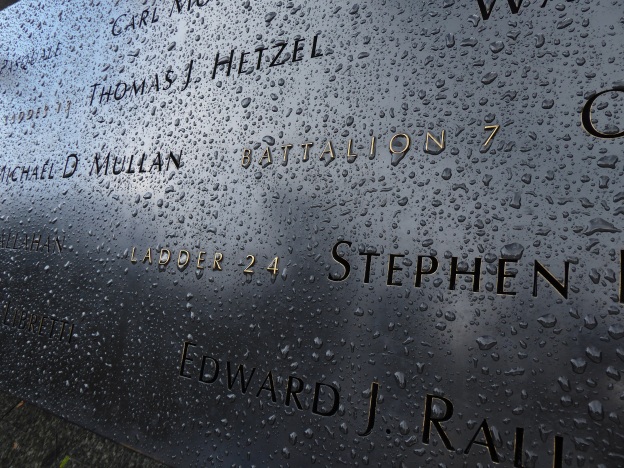
Deep down in our spirits, we know that each one of us matters; uniquely, eternally, matters. Our very existence has significance, and we strive to honour and respect the memory of those who have gone, as if the act of forgetting somehow wipes them out forever, and makes them of no account. This came home to me most recently at the sombre and moving memorial on the site of the twin towers in New York, where the names of those who died are recorded – not on some inaccessible wall or behind screens, but on plinths where they can be read and touched.

Each name represents a person made to reflect God’s character in the world; represents so many experiences, hopes and achievements – and above all a person for whom the world was made. We do well to remember that the terror and destruction of that day – and of so many other dark days in human history, like the Holocaust, the genocides of Africa and the Balkans, the purges of Stalin, Mao Tse tung and the Khmer Rouge, the great world wars and the invisible and forgotten conflicts that drag on today – all of these happened to ordinary people like us. In remembering, we express our own fear of being forgotten, swept away like dust with nothing to show we had ever lived.

Memorials are a cry against annihilation; a plea for it not to be true that after we die, there is nothing!

The bible teaches very clearly that the spirit in us is speaking a truth – that we are made for more than a few years of mortal life, and that our lives do have eternal significance. We have an inheritance – literally a place with our name on it – in the new heaven and earth which God is unfolding. No one can take that from us, no matter how short, troubled and apparently insignificant our mortal lives may be.

The shepherd king knows each of his sheep by name – he knows the very number of hairs upon our heads, and every detail of every day appointed for us to live. We matter to him, to the Lord of the universe, to the sovereign over every power and authority and the judge who will at last see righteousness rule over all things. He notices our little struggles and also our little victories; and he appreciates all that we seek to do in his name and for his glory. Even if our names are not recorded in some list of thanks by an apostle, we can be sure that our shepherd sees and values our labours, and we can truly rejoice because our names are written indelibly in heaven.

And there is this promise of a new name, to be given when at last we embark upon our new life with the redeemed in the perfection and joyous freedom of resurrection bodies and complete fellowship with Christ – a name which will maintain both our unique identities but also clearly show that we belong utterly to him.

I rejoice, O Lord, to know that my name is written in your book of life; and I praise you that one day, I will receive the new name which will proclaim to all the congregation of your people that I am your beloved, perfect and accepted, come into my inheritance and at peace!

I just wanna be a… sheep!

Help us, O God of our salvation! Help us for the glory of your name. Save us and forgive our sins for the honour of your name…Then we your people, the sheep of your pasture, will thank you forever and ever, praising your greatness from generation to generation.

(Psalm 79.9&13)

The Lord is my shepherd; I have all that I need…

(Psalm 23)

I am the good shepherd. The good shepherd sacrifices his life for the sheep……I am the good shepherd; I know my own sheep and they know me, just as my Father knows me and I know the Father. …My sheep listen to my voice; I know them, and they follow me. I give them eternal life, and they will never perish. No one can snatch them away from me, for my Father has given them to me, and he is more powerful than anyone else. No one can snatch them from the Father’s hand. The Father and I are one.

(John 10.11,14&15,27-30)

One of God’s many gifts to his children, are the rest of his children! How often are you comforted, encouraged, inspired or helpfully chastened and challenged by other believers? Recently, a friend challenged me to think again about a passage and a concept with which I am so familiar that I realise I had stopped thinking about it! I think it is one of the traps into which long-time believers can easily fall, failing to register the depth of meaning in a passage because we think we understand and have already grasped all it has for us..Praise God, that he doesn’t leave us to our foolishness, but stirs us up to look again, to seek to learn again – old lessons for a new time of life, or new lessons altogether!

The gospel of John contains several passages in which Jesus refers to his people as sheep, and himself as shepherd, building on an image used in the Old Testament by the psalmists and prophets where the people of Israel are God’s flock, and most famously where David rejoices in having the Lord God as his shepherd. Sheep and the whole business of shepherding was as familiar to Jesus’ audience as our own daily routines are to us. The character of sheep, and the necessary qualifications of a good shepherd were  widely understood, so that when Jesus used these things in his teaching, everyone could grasp the message.

We – as sheep who have gone astray, vulnerable and foolish, needing care and protection – have in Christ the ideal and perfect Shepherd for our souls. His love for us – the love which took him to Calvary on our behalf – has shown the value which is placed upon us, a price beyond imagining. He knows us, not merely about us as statistics, but an intimate understanding and delighting in, which mirrors the joyous communion within the Trinity. How hard we find it to let this truth sink deeply into our understanding, to let it inform our thinking about God, and about ourselves as his beloved and chosen people!

By the presence of the Holy Spirit within us, we are increasingly able to recognise the voice of our truth-telling beloved Shepherd, to discern the false voices which might beguile us away from him, and to reject them. That Spirit is also the guarantee of his gift to us, the gift of eternal life, which is the hope of all who trust in Christ – every straying, tired, despairing, or wilful sheep has a place in the Shepherd’s heart and he will not give up on any who truly call him Lord.

Finally, we are safe, and can have absolute assurance of the grasp which Christ has upon us. It is almost as though Jesus were gently boasting here, in the manner of a child..’my Dad is so much stronger than anyone else!!’ But in this case, it is no idle boast, but an earnest reassurance from our Good Shepherd that we need have no fear about our eternal security. I wonder if Paul was remembering these words of Jesus when he wrote this:

Can anything ever separate us from Christ’s love? Does it mean he no longer loves us if we have trouble or calamity, or are persecuted, or hungry or destitute, or in danger, or threatened with death?..No despite all these things, overwhelming victory is ours through Christ, who loved us.

And I am convinced that nothing can ever separate us from God’s love. Neither death nor life, neither angels nor demons, neither our fears for today nor our worries about tomorrow – not even the powers of hell can separate us from God’s love. No power in the sky above or in the earth below – indeed, nothing in all creation will ever be able to separate us from the love of God that is revealed in Christ Jesus our Lord.

(Romans 8.35-39)

I am content to be a sheep; to accept my foolishness and utter need of constant care from a shepherd who has demonstrated such love for me and promised such a future. And I am thankful for other members of the flock who do so much to help me to hear his voice more clearly, and to follow him more nearly!