Tag Archives: Charles Wesley

The power of words(and music!)

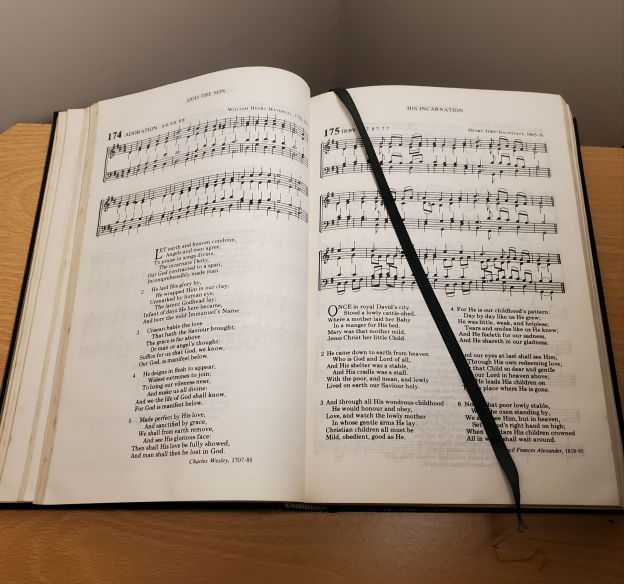
Let earth and heaven combine, angels and men agree, to praise in songs divine, the incarnate deity, our God contracted to a span, incomprehensibly made man.

He laid his glory by, took form in mortal clay; unseen by human eye, the hidden Godhead lay; infant of days He here became, and bore the mild Immanuel’s name.

He deigns in flesh to appear, widest extremes to join; to bring our vileness near, and make us all divine; and we the life of God shall know, for God is manifest below.

Made perfect by his love, and sanctified by grace, we shall from earth remove, and see His glorious face; then shall His love be fully showed, and we shall be complete in God.

(C Wesley 1707-88)

But the angel said to her, “Do not be afraid Mary, you have found favour with God. You will be with child and give birth to a son, and you are to give him the name Jesus. He will be great and will be called the son of the Most High… The Holy Spirit will come upon you, and the power of the Most High will overshadow you. so the holy one to be born will be called the Son of God..”

(Lk 1.30,31&35)

He is the image of the invisible God, the firstborn over all creation. For by him all things were created; things in heaven and on earth, visible and invisible, whether thrones or powers or rulers or authorities; all things were created by him and for him. He is before all things and in him all things hold together. And he is the head of the body, the church, he is the beginning and the firstborn from among the dead, so that in everything he might have the supremacy. For God was pleased to have all his fulness dwell in him, and through him to reconcile to himself all things on earth or things in heaven, by making peace through his blood shed on the cross.

(Col 1.15-20)

Like many others, the music associated with this season of Advent and the celebration of Jesus’ birth is very precious to me. There are hymns which I have sung all my life, and cherish dearly; there are choral pieces which move me deeply, and there are the seasonal pop songs which have accompanied the festive season for most of my adult life.. Music speaks to us on such a deep level, and yet it is worth pondering the words that go along with the tunes (perhaps not so much for the pop songs though!).

The  hymn with which I began today is not commonly sung at carol services, and you probably won’t hear it on the radio during this month. It has no catchy chorus, or soaring descant and there are no animals, shepherds or wise men – Mary and Joseph make no appearance. BUT it is absolutely all about the incarnation, and the revolutionary mission of our Lord. The writer, Charles Wesley has gifted the church many great hymns, and like them, this  text of this one is incredibly rich. One website lists 32 scripture references across the six verses of this hymn. I am reminded that we can help ourselves so much to learn, understand and grow in faith by singing and meditating on the words of songs and hymns: words which are themselves the product of long pondering by saints – long ago and today. Together, these old and new songs speak nourishing truth, writing the realities of faith across our memories and minds in melodic ink, so that it stays there!

This particular hymn points to the many aspects of the work and glory of Christ; to the marvellous mystery of his mission and his victorious achievement; and to the  fulfilment of God’s plans for redemption. It reminds us of the many passages throughout scripture which reflect truths about God’s Messiah, and which leave us slightly reeling, and aware that we haven’t begun to comprehend the breadth, depth and height of the love of our God!

I am looking forward to singing the Christmas songs again, to listening to the choirs and letting the beauty and power of their art lift my spirit in praise and thanks to the Author of all good things, and above all the Father of our Lord Jesus Christ, the architect of the great plan of salvation. I hope that as I sing, I will let the words fall fresh on my heart and mind, so that they bless me as they have done before and I am brought to worship before the incarnate infititude, the tiny enormity of God, contracted to a span.. incomprehensibly made man.

When life gets holes in it….

Lord, God of my rescue, by day I cried out, by night, in you presence. May my prayer come before you. Incline your ear to my song. For I am sated with evils and my life reached the brink of Sheol..

You put me in the nethermost pit, in darkness, in the depths. Your wrath lay hard upon me, and all your breakers you inflicted… My eyes ache from affliction. I called on you, Lord, every day. I stretched out to you my palms..

As for me – to you, Lord, I shouted, and in the morn my prayer would greet you. Why, Lord, do you abandon my life, do you hide your face from me?

(Ps 88.1-3,7,8,10, 14&15)

I know someone who describes their existence since the experience of early widowhood as being like ‘life in black and white’. She is one of the most godly women I have ever known, and her life as a widow has been full of service to others and relative peace and contentment. And yet… all the colour and joy has gone.

Are you mourning today? The death of a spouse, the death of a sibling, the death of a child? The passing of a parent, or a close friend? The loss of health and autonomy? The loss of satisfying employment or a precious relationship? The loss of a dream? The loss of hope for reconciliation and renewal?  What do we do when life seems to be ripped apart by loss, when the reality of our fragile hold on health, well-being and life itself has been forcibly demonstrated and we are weak with grief, dazed with loss, stunned into dumb agony?

Our culture shies away from recognising the incredibly limited control we actually have over our lives, so that it is easy to be lulled into a false sense of security, and any experience of loss becomes un-natural and outrageous.

Dear friend, loss is not only natural but inevitable in our fallen world. The question is not will it come, but rather, how must I prepare myself to respond to it? What does my God require of me, his all-too-frail creature, that I might rightly glorify him and be sustained through this experience. What do I do with my pain?

The topic is far too significant to be addressed in one short conversation, but today I would point you to saints who have shown the way for us, leaving words that we can use, and wisdom that we can learn from. First in this great hymn..

Jesus, lover of my soul, let me to thy bosom fly, while the nearer waters roll, while the tempest still is high.
Hide me, O my Saviour, hide, till the storm of life is past; safe into the haven guide;
Oh, receive my soul at last.

Other refuge have I none, hangs my helpless soul on thee; Leave, ah! leave me not alone, still support and comfort me.
All my trust on  thee is stayed, all my help from thee I bring; cover my defenceless head with the shadow of thy wing.

Wilt Thou not regard my call? Wilt thou not accept my prayer? Lo! I sink, I faint, I fall—
Lo! on thee I cast my care.
Reach me out  thy gracious hand! While I of thy strength receive, hoping against hope I stand, dying, and behold, I live.

(Charles Wesley: 1707-1788)

Wesley invites us to ditch our pride and all pretence of competence – fling yourself upon the Lord, plead recklessly and constantly for his aid in full confidence that he will supply your need.

Then Elisabeth Elliott – twice widowed and thus purified through extreme suffering – says this: offer up your pain to God, to do with it as he will. Make it your offering to him and then give thanks that he can – and will – work in it for your blessing and his glory. For her, widowhood became ‘ a gift, a call and a vocation, not merely a condition to be endured’. Having received it from the Lord, she then offered it up for his use, and chose acceptance and trust. (Eliott, E. The Path of Loneliness, 1988)

None of this takes away pain; it doesn’t replace what is gone: but it may transform our thinking and attitude to the losses which we will inevitably experience. The missionary Amy Carmichael learnt this lesson over many years of suffering, and pressing hard to bring it to God in the darkness of grief. Her poem ‘Nothing in the house’, is a meditation on knowing God in the midst of it. May it speak comfort and encouragement to you today.

Thy servant Lord, hath nothing in the house, not even one small pot of common oil;
For he who never cometh but to spoil hath raided my poor house again, again,
That ruthless strong man armed, whom men call Pain.

I thought that I had courage in the house, and patience to be quiet and endure,
And sometimes happy songs; now I am sure thy servant truly hath not anything,
And see my song-bird hath a broken wing.

My servant, I have come into the house – I who know Pain’s extremity so well
That there never can be the need to tell His power to make the flesh and spirit quail:
Have I not felt the scourge, the thorn, the nail?

And I, his conqueror, am in the house, Let not your heart be troubled: do not fear:
Why shouldest thou, child of mine, if I am here? My touch will heal thy song-bird’s broken wing, and he shall have a braver song to sing.

(Amy Carmichael : 1867-1951)