This is my story, this is my song..

Give thanks to the Lord, for he is good! His faithful love endures for ever. 

Has the Lord redeemed you? Then speak out! Tell others he has redeemed you from your enemies.

For he has gathered the exiles from many lands, from east and west, from north and south.

(Ps 107. 1-3)

On Christmas Eve, in our little corner of a big city, a group of christians from local congregations gathered on a street corner to sing carols, to pray and to hear again from God’s word the story of Jesus birth.

It was a filthy night of weather, we were wet, cold and buffeted by the wind. Barely anyone passed by, nor could they have heard much if they did! But it proved to be one of the most meaningful events in my celebration of Christmas this year, because we were free to do it. We can publicly declare our faith and tell the story of God’s love born into our midst.

No one called the police and reported us for ‘illegal’ activities, no one threw stones or even hard words at us. We are privileged to live under a system of law which protects our freedom to gather for public worship, and it truly is a privilege, a gift and blessing! As we enter a new year and look to the opportunities which may lie ahead, I am challenged by these words from the psalmist. Do I speak out?

I have a story to tell, of salvation and of life lived in the presence of my God. I have been given the good news of Jesus Christ to share; the best gift anyone could ever receive is mine not to hoard but to advertise! There are no legal restrictions on my witness, I need fear nothing from the authorities.

But I do fear ridicule, rejection, giving offence and being misunderstood, driving someone away instead of drawing them near. I look back over many years of living as a christian and wonder just how many opportunities I failed to take through fear? It seems that so many of those around me who do not know God’s personal love for them are people who would be angry, insulted and hurt if I said anything which suggested their lives were somehow lacking. Many of them believe that Christianity is outdated, irrelevant to their lives, a source of hatred and violence down the years which should be discarded. They tolerate my faith because I refrain from offending them, but I know very well that I am not free to challenge their position.

So where is my witness? I try to live in a way which speaks of God’s forgiveness and love, his transforming power and presence in my life – hoping that this might somehow prompt questions. But it hasn’t, not yet, not to me…. And I fear that I am simply written down as a ‘nice person’ (if only they knew!!), who suffers from some misguided religious beliefs but is too polite to make a big thing of them.

The picture at the head of this post is of Galilee, the great lake which in Israel today is called Kinneret after the harp which it resembles in shape. The hills beyond are the Golan Heights, beyond which lies Syria, and a dreadful destruction from which the land may never recover. It is here that Jesus walked on the water; here that he sat by the lake and called fishermen to leave their nets; on these hills he prayed through the night and taught his disciples about the kingdom which he was inaugurating.

I believe in a historical Christ, who lived, died and rose again; whose death bought life for me and all who believe in his sacrifice for them; a Christ whose love and indwelling power can and does transform lives. He is my Lord, my Saviour, the lover of my soul and beloved in my eyes. He is my God, my Father, the source of life and power and the one who will someday make all things new so that I will be at home with him forever.

This is my story, my song; may I be given opportunities and courage to tell it, to sing it, and to be privileged to see God at work in the lives of others this year as He continues to work out His good purposes in this world for His glory.

Mourning..at Christmas?

Even in laughter the heart may ache, and joy may end in grief.

(Proverbs 14.13)

So last week our church family held its annual ‘Carols by Candlelight’ event, our building transformed by candle – and fairy – light into a glowing haven on a dark, damp night. Music from the choir, the praise band and the gathered folk themselves, interspersed with readings and video clips to challenge us to look beyond the familiar trappings of the story.

And I stood at the back, weeping inconsolably, bewildered by the force of my grieving, and ashamed to bring it into such a lovely space.

Why, why should I feel wounded and heart-broken as I hear these wonderful words again, words which have marked every Christmas of my life, the story of my Saviour’s birth?

One may be sad at any time of year, and perhaps especially at Christmas when remembering loved ones who have died; realising that life is not working out as you had hoped and that expectations are not going to be realised; recognising that life may be going to get harder, that there are trials and sore tests on the horizon. But it was none of these which I found in my heart last Sunday evening.

I felt myself drowned in the grief of God for a world of human beings whom he loves with a passion which we cannot imagine; and who have consistently refused to recognise his love, rejecting his mercy and scorning his tenderness.

Look around at society today.. chasing material wealth, health and long-life; grasping eagerly at every excuse for a party, a reason to “be cheerful”, trying to live up to the myth of the perfect Christmas and the ideal family. People know that there is more to life than they have already, that is what drives them. But they will not see that in Christ, God has given us what we really need, and that without him, nothing else can satisfy them.

Folk crowd along to carol services, they sing the old familiar songs and watch the old films again; they eat the same foods and play the old games; all reaching vainly after something meaningful and nourishing for their hearts.

But they can’t or won’t see past the glitter, the tinsel, the food and the gifts. The story is there because it has always been there, but they cannot see past the nativity play costumes to the glory enclosed in human flesh; to the priceless gift that Mary held in her arms for the shepherds to adore. Our God, with us, in our mess and desperation; our self-deception and fatal self-sufficiency; our willed blindness to all that might do us good.

Our God, with us, to give us the new hearts that we need to live well, to live forever with him in wholeness and joy.

Is it not enough to make us weep? That we who have been given this gift – through no merit of our own, but entirely by God’s grace and goodness – should be unable to open the eyes of our neighbours, colleagues, family and friends to what we have.

I know it is wrong to despair, but I think it is good to realise a little of how our utterly good God must grieve over this world in its stubborn refusal to hear him. I think that there is a place for mourning at Christmas, for calling out to God by his Holy Spirit to open blind eyes, and breathe life into dead bones. The hymn ‘It came upon the midnight clear’ expresses this so tenderly:

But with the woes of sin and strife the world has suffered long;

Beneath the angel strain have rolled two thousand years of wrong;

And man at war with man, hears not the love song which they bring;

O hush the noise, ye men of strife, and hear the angels sing.

And ye, beneath life’s crushing load whose forms are bending low,

who toil along the climbing way with painful steps and slow,

Look now! for glad and golden hours come swiftly on the wing;

O rest beside the weary road, and hear the angels sing.

(E H Sears, 1810-1876)

The truth is here for all to see… Oh Lord, have mercy upon the closed mind and the proud heart, remove the veil and let people see you in all your beauty.

A divine substitute?

Surely he took up our infirmities and carried our sorrows,

Yet we considered him stricken by God, smitten by him and afflicted.

But he was pierced for our transgressions, he was crushed for our iniquities;

the punishment that brought us peace was upon him, and by his wounds we are healed.

(Isaiah 53. 4&5)

The mystery at the heart of the Christmas story, is the mystery of who this miraculous child really was? Why was he foretold by God’s prophets hundreds of years before his birth, and what is the significance of the way he was described in those ancient writings? Babies were born regularly, frequently, it was nothing new, so why all the fuss about this one?

We have the testimony of the gospel writers, who must surely have had the details directly from Mary herself – who else could have told of the visit by the angel to her home in Nazareth all those months before the trip to Bethlehem? That testimony refers again and again to the prophecies given over the years, which pointed to a coming saviour, one who would save his people, would dwell with them, would bring justice, an eternal rule of peace, and real healing of our sin wounds.

We have Jesus own testimony about himself, coming as the fulfillment of all the old testament scriptures, coming as the one who would reveal God to his people, and would lay down his life for his sheep.

We have God’s direct testimony, at Jesus’ conception, birth, baptism, transfiguration, and ascension into heaven. This was God’s own son; beloved, sent, broken and blessed – for the redeeming of the world.

So on the one hand we have a very simple story; a young woman conceives and gives birth to a son. On the other hand we have a mystery which enchants and inspires us even as it perplexes us; God himself is enclosed in embryo, the creator of the universe submits to the process he himself devised, and takes on human flesh. When he was finally born in Bethlehem, the angelic host could contain themselves no longer, and burst forth in praise and adoration to announce to the shepherds that something absolutely unprecedented was going on!

All through his life, the paradox continued to develop. He was fully human, and lived a sinless life; He was sent to save his people, yet never raised a sword or led an army; He came in fulfillment of all the scriptures, yet the religious leaders opposed and hated him, utterly failing to recognise him. And ultimately on the cross, his death in disgrace and shame was to be his greatest triumph and the means by which his mission was accomplished. By his sufferings for our sins, all those who trust and believe in him are set free from the consequences of sin. His death for us, conquers death for us. His life laid down for us, births new life in us. What a mystery, what profound depths are these to consider!

This is the child whose birth we anticipate and celebrate over again each year; this Christ, the helpless baby who was also the eternal, all-powerful word of God. I am so thankful that at the heart of the story of Christmas is this great mystery, from which every year I am freshly blessed and find new cause for praise and thanksgiving. It is no empty sentimental excuse for a party, but the only gift which could ever really do me good, given by a God whose love I have every reason to trust.

The best songs are the ones which focus my thoughts on this truth, the simple, stunning reality that in Christ, God sent someone else to take my place; and this week, I have been singing one of the simplest and best of them. I close with it, and pray that for all of us, this truth will shine like the light in our darkness in the days ahead.

Child in the manger, infant of Mary;

Outcast and stranger, Lord of all!

Child who inherits all our transgressions,

All our demerits on Him fall.

( Mary Macdonald, 1817-1890; tr Lachlan Macbean, 1853-1931)

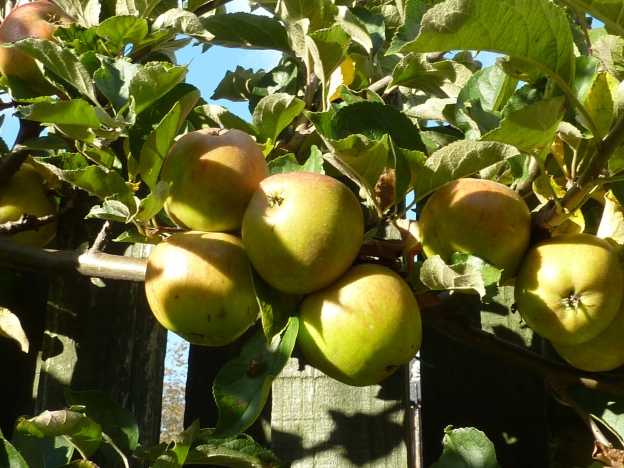
Jesus Christ, the apple tree?

The tree of life my soul hath seen, laden with fruit, and always green,

The trees of nature fruitless be, compar’d with Christ the apple tree.

His beauty doth all things excel, by faith I know, but ne’er can tell,

The glory which I now can see, in Jesus Christ the apple tree.

For happiness I long have sought, and pleasure dearly I have bought; 

I missed of all but now I see ’tis found in Christ the apple tree.

I’m wearied with my former toil, here I will sit and rest a while; 

Under the shadow I will be of Jesus Christ the apple tree.

With great delight I make my stay, there’s none shall fright my soul away,

Among the sons of men I see, there’s none like Christ the apple tree.

I’ll sit and eat this fruit divine, it cheers my heart like spiritual wine.

And now this fruit is sweet to me, that grows on Christ the apple tree.

This fruit doth make my soul to thrive, it keeps my dying faith alive;

Which makes my soul in haste to be with Jesus Christ the apple tree.

(  Anon , first published in the 18th century)

Old songs can be hard to sing, hard to understand, because their language is antique and unwieldy, words have shifted in their meaning, and images and allegories which were once familiar are now strange.

Many of the older songs traditionally sung at Christmas come under this heading, and I appreciate that for this reason, few modern leaders choose to use them in congregational worship. But if – like me – you have enough of a taste for old language, for rich imagery in praise, then there is great sweetness in these pieces.

The picture of a tree full of fruit and goodness is an attractive one, and for the Christian, the image immediately conjures up the tree of the Garden of Eden – of the knowledge of good and evil – where humankind first rebelled against God and rejected his authority in their lives. But the tree of life is described in detail in Revelation 22, with its continual fruit and leaves for the healing of the nations. This tree is not a source of curse and loss, but of healing and life! And we know that it is in Christ, by his work on the cross, that we are healed and restored to newness of life.

The beauty of Christ’s love for us, that heart-piercing loveliness which brings us to our knees in adoration of the one who counted us worth dying for, makes this tree the one above all which we cherish, and prefer. Nowhere else are we so satisfied as here, and here we rest, as in the shade of a tree on a hot day. In Christ we rest, because all the labour of our salvation was his, not ours, and he has extended to us all the privileges of glory to treasure.

And so we live by his fruit, because it is the forgiveness which he won for us which lifts us out of darkness into light and God’s favour; it is the new life which is ours in him that enables us to live in hope in this world and with confidence for the next; it is the constant presence of his spirit within us, like the food which nurtures our bodies, that feeds our souls, our faith, our walk with God. If I do not eat, I die; and if I refuse the fruit of my precious Lord, then surely I will starve and waste away, and the life which Christ died to give me will be a travesty, a ghost and dreadful to see.

So as I anticipate the feast of Christmas, celebrating the coming of Jesus, God with us, I will feast on the great images which deepen my understanding of him – the Shepherd; the Gate; the Water of Life; the Bread of Life; the Alpha and the Omega; the bright morning star; the Messiah; the son of David… and the apple tree!

May we be richly nourished in the days ahead..

May I come in?

“If you love me, you will obey what I command. And I will ask the Father, and he will give you another Counsellor to be with you for ever – the Spirit of truth…you know him for he lives with you and will be in you. I will not leave you as orphans, I will come to you….. If anyone loves me, he will obey my teaching. My Father will love him, and we will come to him and make our home with him.”

(John 14. 15-17 &23)

Human beings are made in the image of God, made to reflect creativity, strength, compassion, love, to one another and the world. We are made by a God who is three-in-one, a God who is community and endless loving communication. We are made for community, to give and receive, to speak and to listen, to exist in relationships of such trust that we have no need to hide anything of ourselves. That is what lies behind the picture of Adam and Eve walking naked in the Garden of Eden, sharing with God in the cool of the day.

And when we rebelled against God, we broke the image; we all now live with the curse of needing community, but struggling to create it because of the ways our fallen nature has twisted us. We project images of ourselves which we hope will give us a peaceful life, protect us from abuse or ridicule, enable others to accept and like us. But so often these are not the truth, rather a facade behind which we hide – longing to be known utterly, but afraid to be known, full of shame and fearful of rejection.

So we live, even within the closest human relationships, behind closed doors, locked away and unable to enjoy that sweet ease which comes from being with one who accepts and loves us unconditionally. We cannot make and keep the connections which create deep relationships without exposing our secrets, trusting another flawed human being to be gentle with us, willing to forgive them when they hurt us – as those closest to us surely can. How many of us truly manage to do this?

What hope is there then for meeting this deep need within our beings, for finding that soul food of fellowship and acceptance from which we can then give unconditional love and acceptance to others?

Our hope is in our good and gracious God, who knows better than the greatest physician or psychologist just exactly what ails us! When once we have seen and loved Christ, acknowledging his mercy and majesty and accepting his forgiveness, we are made new, made fit for the most intimate fellowship with God. That is what Jesus was telling the apostles in his last conversations with them as recorded by John. We need never feel alone or isolated again, because Father, Son and Spirit are ever present with us. Every aspect of our character and experience is known and accepted in love. As we rest more and more in that heart of God’s love for us, we are able to give love without expectation of return, and no longer depend on the approval of anyone else for our peace of mind and sense of worth.

In this season of Advent, I will be celebrating the coming of Immanuel, which means ‘God with us’.

With me – here, today, in my mess and weariness:

With me – tomorrow, in the unknown future:

With me – in joy and triumph, as well as fear and doubt:

With me; loving me; listening to me; sharing his heart with me; taking joy in my joys and feeling my sorrows:

With me from now until the day comes when all things are made new, when all the remaining hindrances that hold my attention away from him are removed, when I shall see him and know even as I am known.

Alleluia, Come Lord, Come!

It’s all just so… wrong!

O God, do not keep silent; be not quiet, O God, be not still.

See how your enemies are astir, how your foes rear their heads. with cunning they conspire against your people; they plot against those you cherish.

(Psalm 83. 1-3)

Do you ever get really desperate with God about the mess that things are in? I do, I find myself full of questions and anger that so much beauty, love, and goodness are being assaulted, wasted and destroyed on a daily basis. I get furious that God’s people across the world are being oppressed, attacked and martyred every month. I despair over the ways that the family of God, the church, the body of Christ, manages to misrepresent the truth about its Lord – we fight and quarrel, we stand over in judgement against one another; we acquire wealth and status, and love to sit in the seats of power, while neglecting to love our needy neighbours and to wear the garment of humility in all our dealings with men.

It is therefore with great relief that I turn to the Psalms, to the book of songs recorded for the people of God to use in worship and in prayer, and from which generations have been blessed. These songs are not like many of those we sing nowadays, which might give the impression that being a Christian is an easy or instantly fulfilling life. Very few of our modern writers manage to accurately mirror the truth about our life of faith, with all its struggles, doubts and darkness – which are not a passing phase, but things we will live with until God takes us home and makes us new.

But the psalmists know real life. Their songs speak to my own situation, and give me words to use in prayer and worship as I come before God, as I live before him in daily life in this broken world. Do you ever think of your lament as a form of worship? I believe that it is, a most profound act of surrendering our questions, doubts, fear and anger to the one who above all has the power to heal, answer and quieten our storms. The throne of the almighty is THE place of justice, of appeal against wrong and evil. We give the Lord of Hosts his rightful place when we call upon him to put right all that is so painfully wrong in his world. It is when we recognise our own pitiful limitations and cast ourselves entirely upon him that we truly worship – give him his full worth. So let us not hold back, but come often to lay down our burdens of grief, discouragement, fear and anger at the ways which our world and particularly our race, are damaged.

It is good to be sufficiently alive to the goodness, glory and love of God that we see and feel most keenly the evil, darkness and hatred of this world. I didn’t say it was comfortable! The greater our understanding of God, the more deeply we will mourn over the ways in which his children have rebelled against him and are destroying all the beauty he has given them.

As we grow in our understanding of God’s love for us, in the riches which are available to us through faith in Jesus Christ, so we will become more and more tender-hearted toward our fellows in their need to be saved. John tells us in his gospel that “Light has come into the world, but men loved darkness instead of light because their deeds were evil.”(Jn 3.19) Do we not see this? People reject the witness of Jesus’ followers, they shut their ears and will not listen to the offer of life, forgiveness and restoration, because they do not want to see the truth about their deeds. They would rather remain in the darkness – and how heart-breaking is that for our Father God?

When we grieve and lament over the broken lives, and corrupted world we inhabit; when we come before the One who made all things to be good and share something of his pain; when we receive a fresh vision of his love and mercy towards the lost, then we find that our witness becomes more urgent, our prayers more fervent, and our rejoicing in daily blessings more whole-hearted.

How right the psalmists were, to bring their grief and anger to God, who can use these experiences to strengthen and equip us to be more faithful servants, and to live even closer to him. Praise the Lord, O my soul!

How long, O Lord?

Not again, please, not again Lord:

Sudden death and destruction coming on ordinary people:

Hate erupting into horror, devotion to a cause driving men to desperate extremes and deliberate evil.

How can we bear it..

How can You bear it?

When You created us in Your image, it was not for this:

When You breathed life into us, made us spiritual beings, it was not for this:

O God, holy and pure, filled with light as we are filled with darkness, have mercy upon us.

We are pulling down catastrophe upon our race;  through hatred, greed, laziness and neglect we dishonour Your image within us, and wreak havoc upon one another and the world You created for us to cherish and enjoy.

O God, mighty and good, utterly just as we are utterly corrupt, have mercy upon us.

We are fully deserving of judgement, there is no goodness in us, except where pale reflections of Your image within us remain, and by their light serve to show how dark are our deeds and thoughts.

O God, faithful and true, steadfastly loving as we are fickle and unreliable as the wind, have mercy upon us.

Although the truth about You has been revealed through creation, and all may know that there is a God in heaven, we have chosen to worship instead the things of this world, becoming enslaved by our own desires and fears; have mercy upon us.

Today we kneel before You, in silence, acknowledging our part in the woes of the world, our own weakness and waywardness, and sharing the grief and pain of those who suffer. Today we cry out for mercy upon those who are in desperate need of comfort – for the body and the spirit. Today we cry out for justice to be seen and done for those who have been desperately wronged. Today we confess that we have sinned and fallen short of the glory which is Your perfect way, and we deserve condemnation just as much as the terrorist, the murderer, the oppressor and abuser.

Only in Christ, only through the sacrifice of the perfect one, do we have hope, and a promise for redemption. So in Him we trust, and out of our desperation we cry to You for this world to know and trust in Him also, that we might see peace, healing and fulness of life as all nations find their true fulfilment in following and worshipping Jesus.

Christ, have mercy;

Lord, have mercy;

For in You alone, our hope rests.

God of the impossible….

“How hard it is for the rich to enter the kingdom of God! Indeed, it is easier for a camel to go through the eye of a needle than for a rich man to enter the kingdom of God.”

Those who heard this asked, “Who then can be saved?”

Jesus replied, “What is impossible with men is possible with God.”

Peter said to him, we have left all we had to follow you!”

“I tell you the truth,” Jesus said to them, “no-one who has left home or wife or brothers or parents or children for the sake of the kingdom of God will fail to receive many times as much in this age and in the age to come, eternal life.”

(Luke 18. 24-30)

Many of us are familiar with the sad story of the rich young man who came to Jesus seeking assurance of eternal life, and who went away downcast, because Jesus challenged the stranglehold which his wealth had on his heart – he could not let it go, it had become his god. That is the point of the hilarious picture of a camel squeezing through the eye of a needle – it is simply impossible, laughable and to be dismisssed. In human terms that is… and that is the point which Jesus made to those who questioned how anyone could be sure of salvation if even a rich and law-abiding person could not. With God in the picture, everything changes!

It is God who can do the impossible. By his power at work in hearts and minds, he transforms people so that they recognise the idols which are dominating their lives, and brings them to a point where they can surrender everything to God as rightful king and lord. The proper names for these things are repentance and faith, and they are not once-in-a-lifetime experiences either. It is true that for many people there will be a particular occasion when they know that a decision has been made, to follow Jesus, to accept forgiveness for past sins, and to trust him for the future. But it is also true that as disciples, we spend the rest of our lives working out in each new situation, what we need to repent of and what it means to exercise faith in God as our trustworthy heavenly Father!

I think that I have a bad habit of forgetting what Jesus says in the passage I quoted above – that it is God whose ability and strength is the issue, not mine! How often do I look at a situation and feel overwhelmed, unable to cope with what is being asked of me?! If God is sending me along a particular path, then He is also providing the resources which I will need as I go – and I need to trust Him to be faithful, and to recognise the things which are holding me back.

The disciples pointed out to Jesus how much they had given up to follow him – and his response is a staggering promise, which holds good for all disciples, that no one will be the loser as a result of their obedience to God’s call on their lives! Do I believe him? When I am faced with the loss of something – or someone – precious to me, do I trust God to provide for the gap which will be left in my life?

How often do we ask God to show us in advance how he will replace what is lost, repay what we feel we are sacrificing?! That is not to trust him, that is not faith in the promise, and I need to guard against such an attitude when I am facing up to the prospect of obedience resulting in loss.

I know that God gives good gifts to his children, but also that everything I am and have is a gift from his hand – not deserved but freely given. I hold all things on an open hand, not in a closed fist, and must learn to say with Job -“The Lord gave and the Lord has taken away; blessed be the name of the Lord.” (Job 1.21)

My God is Lord of the impossible, and in any time of sacrificial obedience, I can and must trust him to do just that, to turn what seems an impossible sacrifice into one which I make gladly for his sake, and one which he will more than abundantly make up for, in the ways which he knows are best for me! Blessed be the name of the Lord!

Daily blessings

Let the heavens rejoice, let the earth be glad; let the sea resound, and all that is in it; let the fields be jubilant, and everything in them.

Then all the trees of the forest will sing for joy; they will sing before the Lord, for he comes…

(Ps 96.11&12)

I have a great delight in trees, and my family and friends are accustomed to my stopping in the middle of a conversation to point out some particular specimen of notable colour, size or shape. Do you ever stop to consider how wonderful it is that God designed one of our primary sources of oxygen, in this way?! These amazing plants can live for hundreds of years, reach high into the sky, weigh hundreds of tons, and as well as being very efficient in recycling carbon dioxide, they are beautiful! God is such a marvellous designer, never sacrificing the form of his creations to their function, and so often leaving us in awe at the multitude of ways he varies the basic form to produce new patterns and structures! In every way, our trees testify to the greatness of their maker, they give glory to him who imagined and realised them, and continually direct our thoughts to worship and give thanks.

Living in a land where there are four distinct seasons is an extra blessing where appreciation of our trees are concerned! In winter, we can rejoice in the forms and patterns created by bare branches and trunks; in spring, the fresh greens take our breath away, and the delicate new leaves enchant us; in summer, the great heavy canopy of green provides welcome shade – from sun or summer showers! – and then comes autumn, like the triumphant conclusion to a great symphony, as the colours riot across the spectrum and the winds scatter the leaves across the streets and parks to create vast carpets of bronze and gold.

I was privileged recently to spend a day on the hills in Deeside with a friend; it was a perfect day, with not a breath of wind, not a cloud in the sky, and the sun hot on our backs. We rejoiced in the strength we needed to climb the hills, the eyes which enabled us to see the panorama of hills, the ears to hear the stags rutting across the glen, and thanked God for so many gifts poured into our lives all in one short day. And as we returned to our car, there came what felt like a special extra blessing.. We were standing among tall birches, motionless and silent, reluctant to leave this glory, when there was a slight rustling sound, and a few birch leaves fell around us – flakes of golden bronze, fluttering down gently to our feet. It was like a benediction, like the kiss which a fond parent gives a beloved child at the end of a long happy day, and we were overflowing with quiet joy.

I believe in a God of justice; a God who cannot live with the blight of sin and who will one day wipe it out of his creation for ever, making all things new, so that the little taste of heaven which I had that day will blossom into a whole new life, beautiful beyond my imagination.

I believe that I will have a home in that perfect place not because of my own efforts after holy living, but because in Jesus, I have one who has made me clean, and through whom I have a certain hope of deliverance from death.

I believe that this God, who loves me through Jesus, loves me as a beloved child, knows me intimately and has made me to know and delight in him. He has revealed his love through Jesus, but every day in so many ways, he chooses to give me personal assurances of his love. The trees are one of the ways that I often feel my Father’s loving touch and hear his song of love – but for each of us it will be different! He knows your heart, and knows how to nourish your spirit if you will let him. The words of the blessing spoken by Aaron over the people of Israel tell of God’s face shining upon his children – glowing like that of a loving father who is filled with delight simply in the presence of his own. Let this light and warmth bring great comfort and strength to our own spirits, grounding us securely in our faithful God.

The Lord bless  you and keep you;

The Lord make his face shine upon you and be gracious to you;

the Lord turn his face towards you and give you peace.

(Numbers 6.25)

Do you trust me?

Do not fret because of evil men or be envious of those who do wrong; for like the grass they will soon wither, like green plants they will soon die away.

Trust in the Lord and do good; dwell in the land and enjoy safe pasture. Delight yourself in the Lord and he will give you the desires of your heart.

Commit your way to the Lord; trust in him and he will do this; He will make your righteousness shine like the dawn, the justice of your cause like the noonday sun.

(Ps 37. 1-6)

What does it mean to say that we trust someone? Sometimes it is that we respect their advice and wisdom, and would be strongly influenced by their counsel in time of decision-making. Other times it reflects a belief that a person can keep our troubles to themselves, providing us with a safe place to share our burdens.

On a deeper level, when I married, I entrusted myself to my husband, giving him access to my life and great power to affect me for good or ill. Why was I willing to do this? Because I believed then, and still do, that he loved me as well as his human frailty permitted, that he desired the best for me, and that he would be good for me. He has given me similar power in his life, and my desire always is to be good for him. I know that I have failed, and will do so again. I have been selfish, short-tempered, and unreasonable, at times unwilling to see things from his point of view because I know that he is right and I am wrong! By God’s grace, we have grown together, and will go on relying on his help to love and be faithful to one another – continuing to be open and vulnerable because we made a covenant together to trust one another in love.

It seems to me that over and over the bible reveals God asking this very same question of us, his children, “Do you trust me?….Do you trust me enough to do as I ask?” And ultimately, our answer to that question depends, as in human relationships, on whether we believe that the one asking for our trust really loves and wants the best for us. Consider Adam and Eve, stewards of paradise, with one single prohibition (given for their protection) that they refrain from eating the fruit of a certain tree. When Eve stole the fruit and persuaded Adam to eat with her, they were effectively saying that they did not trust God to be good for them, that He was unfair and unreasonable! How wrong they were…..

Consider Abraham, who was asked to trust God first of all for a new land which he had never seen; then for safe keeping in Egypt – which Abraham tried to arrange for himself by cunning, and ended up causing all sorts of trouble(Genesis 12). When God asked Abraham and Sarah to trust him for descendants, they showed that they had not learnt their lesson, and again tried to arrange it for themselves causing more trouble (Genesis 16). The hero of that sorry tale was God, who patiently and faithfully kept his promises to Abraham, allowing him more than one fresh start!

Consider David, who was anointed the future king of Israel many years before he was actually crowned, and who endured many trials along the way, when he might well have given up on God’s promise or else – like Abraham – have taken matters into his own hands. There were two occasions when David could have assassinated Saul most conveniently, but he insisted on trusting God to arrange matters, and held back.

Am I willing to trust God with my life, my children, my work and my church family? Do I really believe that God wants the best for us and that, unlike human promise-makers, He is able to deliver it?

What does this kind of trust look like in daily life? When changes come, do I fret and worry over things I cannot control, or do I strive to act and think in ways which reflect my belief that God’s ways for my life will always be the best – even though at times they may be painful and difficult? Am I willing not to interfere with God’s timing, not to grab the things I think He has promised but wait until they are poured into my lap?

If I truly believe that God has and will always keep faith with me, fulfilling His promises, then I must walk in daily obedience, not fretting over what I do not know and cannot control. I must do the present task, even when I see no clear path ahead.

It is my faithful obedience in all the small things, and my calm, joyful acceptance of God’s directing of my life which will speak most loudly of the love which I receive from Him, and demonstrate most clearly His trustworthiness. May I be given daily strength and courage to glorify Him in this way!