Monthly Archives: February 2024

A ready and generous affection

..but love your neighbour as yourself. I am the Lord…. the alien living with you must be treated as one of your native-born. Love him as yourself, for you were aliens in Egypt. I am the Lord your God.

(Lev 19.18&34)

“A new command I give you: Love one another. As I have loved you, so you must love one another. By this all men will know that you are my disciples, if you love one another.

(Jn 13.34&35)

Let no debt remain outstanding, except the continuing  debt to love one another, for he who loves his fellow-man has fulfilled the law…. Love does no harm to its neighbour. Therefore love is the fulfilment of the law.

(Rom 13. 8&10)

Love is patient, love is kind. It does not envy, it does not boast, it is not proud. It is not rude, it is not self-seeking, it is not easily angered, it keeps no record of wrongs. Love does not delight in evil but rejoices with the truth. It always protects, always trusts, always hopes, always perseveres. Love never fails…

(1 Cor 13.4-8)

Love is not proud, and how often pride is at the root of all our disobediences.. love is ready to leap to greet another, ready with a smile, a kind word, a hug. Love is not afraid to show emotion, to be vulnerable and allow others to show love; love is generous, not stingy and mean in measuring out affection. Jesus calls us to love, AS HE LOVES. We can’t say there is no model, but we can choose to justify our deviation from it – and what does that say about our hearts and our sense of how much we are freely, undeservedly, loved?

Last week, as I walked in a big city, I met an old friend who took one look at me, opened his arms and embraced me in the biggest hug. It was such comfort to my hurting heart – he didn’t know that, but our Lord knew that was what I needed, and so he sent me that generous, eager loving heart to greet me as Jesus greets all his children – ” My dear, it is so good to see you!”

That little miraculous moment left me wondering how often we manage to take our opportunities to love generously, to love like Jesus, with no thought of reward, or of what others are thinking?

We all respond differently to different expressions of love, and part of the wisdom of being like Jesus is learning how to say “I love you” to some who don’t like physical displays of affection – what can I do or say to let them know the divine love today? For me and for many of us perhaps, words are a powerful way to both build up and to undermine love. So today I want to think particularly about how Jesus used words and to challenge us all to be more aware of what damage we may be doing by careless talk…

Jesus does not make himself significant by putting others down, by using sarcasm or being patronizing, by mocking those weaker than himself. Jesus infallibly spoke to the women he encountered with an unheard of respect, honesty and as equally beloved to God – an attitude which led them to seek him out, to follow him with devotion and serve sacrificially. This man didn’t belittle or send them back to the kitchen or the nursery, he listened, reasoned and made them know their worth in God’s eyes… Sadly, his church has failed to effectively follow his example very well, but the principle and model are there for us to follow.

Jesus welcomed the children, those suffering from obnoxious diseases and disabilities, and spoke to them as the object of God’s – not patronizing pity- but transforming and empowering love. Jesus took care that his words fitted his hearers, and his divine love and wisdom shine through clearly to show us that it is entirely possible to live as those who choose never to destroy, but always to build up the body of Christ, always persevering and meeting harshness with love and respect.

What will you and I do with our words this week? Will we make excuses and hide behind our busy-schedules, behind particular health/family or employment stresses? I don’t think Jesus leaves us any room for taking out our troubles in our words on those whom we are called to love – He didn’t do it! Will we use the acid-biting sarcasm, the bewildering cryptic comments that leave our hearers feeling utterly stupid, the patronising comments that treat them like less than God’s dearly beloved image bearers?

Will we use words to say instead: “Hello my precious friend, loved and unique, how can I serve you today, how can I encourage you to know the utter security of God’s hold upon you and to have joy in knowing that love, and sharing it?”

I know which one I want to be, and to that end, I share these verses from an old hymn which beautifully expresses that desire to love in the Lord’s name.

I ask Thee for a thoughtful love, through constant watching wise, to meet the glad with joyful smiles, and wipe the weeping eyes, and a heart, at leisure from itself, to soothe and sympathise.

Wherever in this world I am, in whatso’er estate, I have a fellowship with hearts to keep and cultivate, and a work of lowly love to do the Lord on whom I wait.

(Anna L Waring, 1823-1910)

Real life, real faith..

There, by the Ahava canal, I proclaimed a fast, so that we might humble ourselves before our God and ask him for a safe journey for us and our children, with all our possessions. I was ashamed to ask the king for soldiers and horsemen to protect us from our enemies on the road, because we had told the king, ‘The gracious hand of our God is on everyone who looks to him, but his anger is great against all who forsake him.’ So we fasted and petitioned our God about this, and he answered our prayer…..

On the twelfth day of the first month we set out from the Ahava canal to go to Jerusalem. The hand of our God was on us, and he protected us from enemies and bandits along the way. So we arrived in Jerusalem, where we rested three days…

Then the exiles who had returned from captivity sacrificed burnt offerings to the God of Israel… they also delivered the king’s orders to the royal satraps and to the governors of Trans-Euphrates, who then gave assistance to the people and to the house of God.

(Ez 8.21-23,31&32, 35&36)

A song of ascents.. When the Lord restores Zion’s fortunes, we should be like dreamers. Then will our mouth fill with laughter and our tongue with glad song. Then will they say in the nations: “Great things has the Lord done with these.” Great things has the Lord done with us. We shall rejoice.

(Ps 126.1-3; R Alter translation)

There is a task to be undertaken, something we are to do for the Lord – perhaps the life-long task of parenting; or the calling of godly living as a single or married person: perhaps something immediate and challenging, like a difficult conversation, or committing time and energy to a particular project. Every day, we are called to accept the duties and privileges of living as God’s image-bearers in our families, our communities, and to fulfil our tasks as well as we can for his glory and our blessing. Every day, there are choices to be made about how we live, what our priorities are, and whether we trust God to be sovereign over and in all that happens.

Ezra gives us so much to meditate on as he obeyed God’s call and undertook to lead a cohort of exiles back from Babylon to join the group already established in Jerusalem. His task involved a large and long term goal – the establishment of God’s law as the rule of life for all the people of Judah and Jerusalem – which was to be achieved by small daily steps of obedience and faith.

First, they had to get there.. a journey of many miles which took three months across potentially dangerous lands. Ezra recognised the risks – exacerbated by the fact they they carried great wealth with them – and began by calling the people to pray, committing themselves to God in faith, and asking him to honour his name and reputation by protecting them. There is no record of a particular answer, except in the actual experience of the travellers, which spoke clearly of God’s keeping! They asked, and then set off to act – demonstrating faith by living as if God’s promises would be kept.

Having first asked for help, and then experienced it as they obeyed, the people then formally and gladly thanked God for doing as they had trusted him to do! They had experienced the shielding love of God, and now worshipped and praised him for his faithfulness and grace to his people.

It is simple, and yet sometimes so difficult to do:- to ask, to act in faith, and then to take time to give God praise as we see and experience his work. We are tempted to wait for answers before undertaking the work, to look for supernatural guidance, when our sanctified common sense is there to direct us step-by-step. Ezra didn’t wait for a vision; he prayed and then went… Each day, I have the opportunity to take the next steps of service and obedience in the work to which I am called, the small tasks which are building God’s kingdom and fulfilling my purpose for his glory. Will I not trust the Lord to provide what I need for each task, each step? To live steadily and attentively by faith, is to live in thanksgiving, on the basis that what God has said, he will do – may I grow in such faith, that I might, like Ezra, be useful to my God and King.

Never abandoned or forsaken

Where can I go from your spirit? Where can I flee from your presence? If I go up to the heavens, you are there; if I make my bed in the depths, you are there. If I rise on the wings of the dawn, if I settle on the far side of the sea, even there your hand will guide me, your right hand will hold me fast. If I say, “Surely the darkness will hide me and the light become night around me,” even the darkness will not be dark to you; the night will shine like the day, for darkness is as light to you.

(Ps 139.7-12)

“O Nebuchadnezzar, we do not need to defend ourselves before you in this matter. If we are thrown into the blazing furnace, the God we serve is able to save us from it, and he will rescue us from your hand, O king. But even if he does not, we want you to know, O king, that we will not serve your gods or worship the image of gold you have set up.”

(Dan 3.16-18)

But now, this is what the Lord says – he who created you, O Jacob, he who formed you, O Israel: “Fear not, for I have redeemed you; I have summoned you by name; you are mine. When you pass through the waters, I will be with you; and when you pass through the rivers, they will not sweep over you. When you walk through the fire, you will not be burned; the flames will not set you ablaze..”

(Isa 43.1&2)

And we know that in all things God works for the good of those who love him… Who shall separate us from the love of Christ? Shall trouble or hardship or persecution or famine or nakedness or danger or sword? …in all these things we are more than conquerors through him who loved us. For I am convinced that neither death nor life, neither angels nor demons, neither the present nor the future, nor any powers, neither height nor depth, nor anything else in all creation, will be able to separate us from the love of God that is in Christ Jesus our Lord.

(Rom 8.25,35,37-39)

I suspect that I have written about this before, but it bears repeating…. as God’s beloved children, those redeemed by his son and alive with his divine life, we are never left alone to face anything that may happen to us… never.

The importance of grasping this was brought home to me again recently during a bible study discussion of the desolation of those who feel that God has shut them out, that there is silence and no sense of his presence with them. That experience is very real indeed, and can be utterly devastating to the confidence of a believer… not only are bad things happening, but the one source of comfort has become mute, and there is no perception of love, or even interest in their plight. What can we do?

God has asked his people throughout history to trust him in the darkness; to trust him for the improbable and the impossible; to trust him and praise him when things go wrong, and never to believe the lies which have been told from the beginning – that God doesn’t really care for our good, that his ways are not loving, and that we must look out for ourselves. God has called his people to believe that there is something worse than all the troubles which life may bring – and that is to choose to live without him, to deny ourselves the hope of glory and eternal joy, to refuse to believe that there can be a life worth dying for.

When, by faith and the blessed strengthening of the Spirit of God within us, we hold on to God’s promises in the face of severe trials, we defy the darkness and the evil; we claim God’s goodness and our inheritance as his children, and affirm that what lies ahead of us is worth infinitely more than anything we may lose here. This is what Stephen the martyr did; this is what Shadrach and his companions did, and what Paul stated as he endured so much suffering; this is the example that Jesus set for us – enduring the cross, utterly focussed on the good things which God had planned for him, trusting God utterly with everything.

All the promises, all the stories, are there to encourage us in the face of divine silence and apparent inaction. We are to learn that when we feel alone and forsaken, it is never true; when everything seems to be going wrong and we can’t see the good outcome we desire, it isn’t the end. God keeps his children safe as they cling to him in spite of silence and desolation; keeps them through devastating troubles and unspeakable pain; and through death itself he brings them into his nearer presence, prepared for glory and unimaginable fullness of life.

Friends, when the silence is deafening, and the darkness void of love’s warmth, let us take courage and stand firm: praying, lamenting, praising and living as though the promises were true, taking God at his word and knowing that we are not alone.

Remembering well….

When the builders laid the foundation of the temple of the Lord, the priests… took their places to praise the Lord.. :”He is good; his love to Israel endures for ever.” And all the people gave a great shout of praise to the Lord, because the foundation of the house of the Lord was laid. But many of the older priests and Levites and family heads, who had seen the former temple, wept aloud when they saw the foundation of this temple being laid…

(Ez 3.10-12)

‘Who of you is left who saw this house in its former glory? How does it look to you now? Does it not seem to you like nothing? But now be strong, O Zerubbabel,’ declares the Lord. ‘Be strong, O Joshua son of Jehozadak, the high priest. Be strong, all you people of the land,’ declares the Lord, ‘and work. For I am with you,’ declares the Lord Almighty. ‘This is what I covenanted with  you when you came out of Egypt. And my Spirit remains among you. Do not fear…. The glory of this present house will be greater than the glory of the former house,’ says the Lord Almighty. ‘And in this place I will grant peace,’ declares the Lord Almighty.

(Hag 2.3-5,&9)

“Forget the former things; do not dwell on the past. See, I am doing a new thing! Now it springs up; do you not perceive it? I am making a way in the desert and streams in the wasteland…. to give drink to my people, my chosen, the people I formed for myself, that they may proclaim my praise.

(Isa 43.18-21)

As you come to him, the living Stone – rejected by men but chosen by God and precious to him – you also, like living stones, are being built into a spiritual house to be a holy priesthood, offering spiritual sacrifices acceptable to God through Jesus Christ… you are a chosen people, a royal priesthood, a holy nation, a people belonging to God, that you may declare the praises of him who called you out of darkness into his wonderful light.

(1 Pet 2.4,5&9)

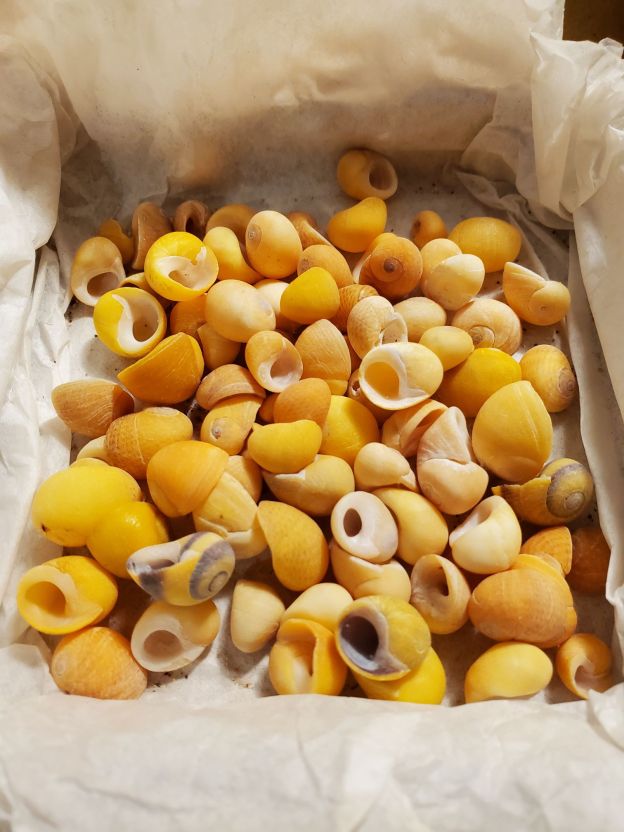
One of the beaches where I used to swim often had lines of shingle and shells thrown up by the tides, and after spotting one, I began to collect these little yellow shells whenever I visited the beach. Now they sit on my desk as a tangible reminder of a special place and season of my life, times of great happiness and precious friendships.

What do we do with such memories? I believe memory is a gift, one of God’s good things for us to enjoy – and like all his gifts, to accept and use responsibly for our blessing and his glory. Will I choose to use memory as a means of growing in faith and thankfulness? Or will I choose instead to cling to memory as a means of feeding resentment, self-pity and doubt?

Many of the people of Israel who returned from exile to rebuild the temple in Jerusalem could remember the old building; the city as it had been before the Babylonians reduced it to rubble and ruins. When the first celebrations took place around the new altar, with the foundations of the new temple visible, they were overcome with grief for what had been lost, remembering past glories and all the people and way of life which had been swept away. We can understand and sympathise with their feelings – who among us has not experienced such complex and overwhelming sadness on revisiting old haunts where we knew precious people and events?

But God knew the danger of such emotions, if unchallenged, and sent Haggai and Zechariah to speak to the people, to channel memory along different paths. When they looked back, it was to see overwhelming reasons to trust that God would fulfil his promises, and to find confidence and courage to obey him in the task appointed to them. Our God is sovereign over time and history, and his ways are beyond our understanding. His kingdom confounds human expectations, his strength looks like weakness, and his wisdom looks like folly. But, he is at work and the final glory of his house will indeed be so much greater than any of us can imagine!

God would indeed build a new house, a people to glorify his name as has always been his plan – and in every age, his ways will be different. Let us then be thankful, that we are part of this wonderful kingdom building, and while we give thanks for what is past, we do not expect or demand that God return to past glories when what is promised is so much better.

Heavenly Father, I bring to you my grief for good things which are past – people and places which are no longer in my life – and pray that you will keep this wound clean and free of any infection of bitterness. Let me be thankful for your faithfulness, for all the past evidences of your power, your love and provision for me. Let me not resent that you have taken lovely things from me, but rather be thankful that I had them, and be hopeful and expectant for the good things which you will yet give.
When I grieve for the state of your church in our land, remembering past glories, great saints and days of joy, let me not give way to despair, but give thanks for your work in those days. Let me take confidence that you are still working, doing new things that are building your kingdom and bringing glory to your name. Let me be part of this work, part of a people who praise your name, and who look back with thanksgiving and forward in expectation.